Associated albums


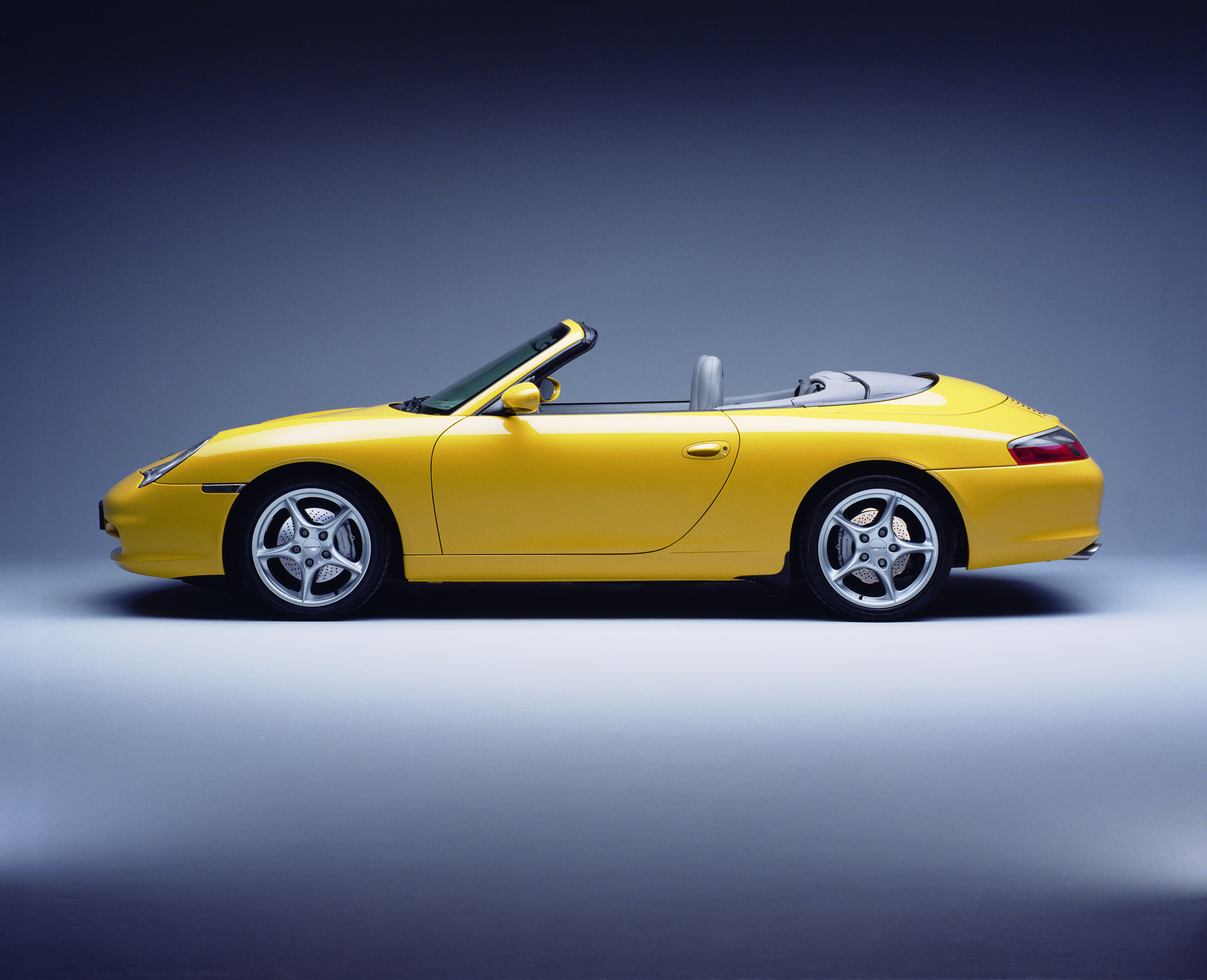
For its limited-production open car, Exclusive held output to just 356 copies, a symbolic number in both Porsche and Speedster history. Where the first car, introduced in 1954, was a cut-rate Spartan affair, built for a price at the request of American distributors Max Hoffman and Johnny von Neumann, its second and third editions levered the concept up market even as they nurtured some of the myth and more of the mystique. Porsche assembled just two Speedsters on the 993 platform, one for favorite son F. A. Porsche and the other for longtime friend and supporter Jerry Seinfeld. The company skipped the 996 entirely. Oliver Herting, product manager for the 911 range within Exclusive, explained the inspiration for the new car to EXCELLENCE magazine’s Ian Kuah: “The Speedster project came out of a discussion on what we could do as a follow-up to the Sport Classic, particularly with an open car.” Faithful to all of its predecessors, the car carried over the manual top and even adopted and updated the twin-hump tonneau that covered the rear of the passenger compartment and the top when it was stowed. Based on the C4 body shell, Exclusive lowered the S Cabriolet body by 1.6 inches and cut the windshield frame height by 2.4 inches. Porsche offered the car either in Pure Blue or Carrara White, with the sales split coming up nearly equal. The car was available to customers in the United States despite receiving the performanceenhancing 408-horsepower-inducing PowerKit, a fact that in the past had excluded American buyers from such offerings.

The 2011 Turbo S arrived next, resetting a calibration on performance expectations for drivers who might never achieve record-shredding lap times on the Nurburgring. The word subtle applied again with this model as Weissach’s Style Porsche never lost sight of the dictum that great design required great taste and great judgment. Another wag described it as knowing when to lift the pencil. Externally, the S looked only slightly different from and slightly more aggressive than the standard Turbo, with an often indefinable something about it that even cognoscenti sometimes missed. Taking advantage of the DFI enhancements to the 3.6-liter Mezger block, but essentially doing nothing with either the turbos or the intercoolers while increasing boost from 1.0 to 1.2 bar took horsepower up to 530 throughout the range from 6,250 to 6,750 rpm. With this output and the PDK transmission, acceleration time from 0 to 100 kilometers per hour took a brief 3.1 seconds. Porsche worried that its robust six-speed manual gearbox might struggle with this much, so the PDK was the sole transmission offered. Any lingering weight-transfer and cornering issues completely disappeared with the new car’s active engine mounts, counteracting longitudinal and lateral acceleration instantaneously. To develop Porsche’s final offering on the 997/2 platform, its RS 4.0, to reach its four-liter displacement, the racing engineers at Flacht developed a 4.0 for the GT3 RSR and GT R models. For this road version, they plugged the same new crankshaft—with 4-millimeter-longer stroke, at 80.4 millimeters—into the production-bound engine derived from the already bored-to-the-max 3.8-liter split case. Along with this milestone displacement came milestone power output reaching an even 500 horsepower at 8,250 rpm. The Carrera RS 4.0 profited as well from decisions made by the same engineers for the GT2RS handling, and it blended the best of bits from the GT2 and the previous generation RS 3.8 models. Porsche manufactured 600 for the world. THE SEVENTH GENERATION: TYP 991 “We had this idea to lengthen the 911’s wheelbase long ago,” August Achleitner said, “even before 2006 when we first started investigation into the next car.” The longer wheelbase became one of the new car’s most controversial changes. “We didn’t say exactly 100 millimeters, but it was roughly that number in 2003. That’s when we started development work on PDK, and we considered the technical requests from our chassis engineers to make the wheelbase longer.” It simply wasn’t practical for the 997 and so it was an idea that got filed away. This was not, however, Porsche’s first wheelbase increase. The span increased for the first time in 1969 when engineers added 2.24 inches. During the step from 993 to 996, Weissach stretched it another 3.2 inches, a move that Achleitner and his chassis engineers still consider “quite a good step,” he said. “The reason came out of decisions for vehicle dynamics, to make the car more stable, more calm, more precise. But widening the front track was as important to the engineers as the longer wheelbase.

“By widening the front track we can support more rolling forces by the struts, and this allowed us to make the stabilizer a little bit thinner and not so stiff. Simultaneously this avoids understeering. So this new car is much more neutral than the 997. And with this new feature, the PDCC, Porsche Dynamic Chassis Control, it’s completely another world.” Weissach developed PDCC to limit body roll on its larger vehicles, the Cayenne and the Panamera. “I’m honest here,” Achleitner said, laughing, “we had several discussions: PDCC in a sports car? My God, are you serious? We are adapting Cayenne technology to our sports car? Can that be? “It makes a sports car completely different because it avoids any body roll. By avoiding rolling, we can keep the tire in its optimum position to transmit the maximum of forces to the road in every dimension. So this car is 14 seconds faster around the Nurburgring than the 997, but only four of those 14 come from PDCC. The rest is this longer wheelbase and wider track. It is 52 millimeters wider, so about one inch on each side. The structure takes up part of this number because we needed a little more space for the 20-inch wheels—the whole wheel, its diameter, its depth, to allow it full turning capacity.” The Carrera S rode on 20-inch tires, the Carrera on 19s. Those familiar with Porsche’s development process knew the engineers set goals or targets and they expect to encounter conflicts along the way. “The target and the conflict,” Achleitner continued. “One of these. Bigger wheels have a lot of disadvantages. They need more space; they are heavier. When we started the development, our chassis guys came to me and said, ‘We want to install twenty-inch wheels.’ And I said, ‘Well, okay, but first, go home and make a comparison between advantages and disadvantages. Because there are a lot of disadvantages.’ But finally, the number of advantages was bigger than the disadvantages because we can transmit more forces because of the bigger contact patch and we can reduce the tire pressure because the possible tire load is higher with these tires than it is for the smaller tires. This is another small step not only to make the car faster but to make it more comfortable.” Tire, road, and wind noise intruded into the 997 cabin, but it became an issue too late for Achleitner’s development engineers to fully address it at that time. It involved chassis and tire engineers, aerodynamicists and body designers, and the interior group. It was another target conflict that provided an unanticipated opportunity to heighten the driving experience for buyers. “It was not a target from the start,” Thomas Wasserbäch explained. He was general manager for 991 base engine development. “The new car is so much more quiet. Less tire noise, less wind noise. And by reducing these noises there was some space left in our ears for the engine noise we wanted to hear,” he said. That led to the Symposer, a joint development between Porsche and the Mann+Kummel Group in neighboring Ludwigsburg. Their multichamber module transferred acoustic pulses from the air intake through a funnel-like opening that housed a tuned membrane.

“From there we ran a tube to the steel bulkhead at the rear of the passenger compartment,” Wasserbäch continued. “We developed a new exhaust system that merged the exhaust gas for all cylinders in a new manifold—in the past our Boxer engine sounded like two three-cylinder engines. The new system sounded like there are six cylinders, and we ran a tube from there as well. That steel bulkhead became the subwoofer for our exhaust system. And our sound is mechanical, not synthetic; outside the car you heard exhaust. Inside you heard intake and engine. The sound Symposer brought outside sound in. And incidentally, you could deactivate it if you wanted a quieter ride by pushing a switch on the console.” The 991 represented a fresh start with countless opportunities. With the 997, stylist Grant Larson sketched bigger tires onto his concept drawings and this sent chassis engineers back to their computers to redesign and strengthen rear structure and suspension to handle the additional stresses the larger tires introduced. The 991 emerged differently, and in the end only a few internal pieces of the direct fuel-injection type 9A1 Carrera and Carrera S engines survived the transfer process. “In the structure of the 997 we started with the 996,” August Achleitner said. “Of course we modified it, tire sizes, and so on, into the 997. But the structure basically was the same. Over time we had to reinforce it in several locations, sometimes just to make it suitable for all these crashes that were required. But then the car began to go away from its optimum. You can do it for one generation, maybe for a second one. Maybe. But then it’s over. “You have to throw it away and take a clean sheet of paper,” he went on. “Now you have to make a development for the next six or seven years, as long as you know the requirements for the structure.” Engineers understood there would be 21 variations of this car. Long-term requirements influenced the design and development of the controversial electronic steering. “We looked at every system out there,” Michael Schätzle explained. Schätzle was project manager for the complete 911 product line. “We didn’t like anything we drove. So we started from scratch. And that gave us the freedom to develop our own parameters, to address the way Porsche 911 drivers use their cars.” The new system employed a vehicle status sensor that constantly calculated forces impacting the steering rack-and-pinion from road and steering wheel inputs, such as steering angle and vehicle speed. The sensor interpreted these data and sent a calculation to an electric motor on the steering rack that applied appropriate steering torque by means of toothed belts and a recirculating ball. Steering feedback, crucial information about road surface and driving conditions, came to the driver through the steering wheel. The new 991 benefited profoundly from predevelopment. Dr. Heinz Soja arrived at Porsche in 1999 and helped establish the group that now tackles all things technical for any new vehicle. As each phase of vehicle development reached “freeze,” the moment at which specifications, designs, innovations, the appearance, the options, were set, the new ideas that each engineer and designer had devised went back into their desks to be retrieved when they started considering the successor. For Soja and his team of 70 engineers, these became the technical columns that defined the new car. “We looked intensely at our competition,” Soja said. “In this case, that even was our 997. And we asked ‘What are the mistakes in these cars?’” Porsche’s new motto, “Intelligent Performance,” was more than a catchy phrase. For the engineers at Weissach it was a guiding philosophy they used in reaching the primary target for any new 911: it must be faster than its predecessor. Every target seemed to come with a conflict. To be faster required more horsepower from a larger, heavier engine that used more fuel; better performance required a lighter-weight automobile, perhaps made from more expensive materials.

STEERING ELECTRONICALLY Porsche engaged its longtime development driver Walter Röhrl repeatedly in developing the new car. It was Röhrl who posted the 991’s 7:40 Nurburgring lap time. Nowhere was his input more important than with its new E-steering system. “We spent five days developing the steering on the handling course at Nardo in southern Italy,” he said. “Then the engineers went back to Stuttgart and worked on parameters. One test we gave very much attention was driving in snow. Sometimes when you drive fast in snow you need to turn the wheel very rapidly to control the car and the system must keep up but not overcontrol it.” Holding an imaginary steering wheel in his hands, he snapped his arms to opposite lock. “They worked on that. Then we just spent three more days at Nurburgring. That was all it took to make it perfect. One thing the E-steering does is makes driving less fatiguing by filtering out minute road imperfections. “Our biggest challenge with this new system,” Achleitner recalled, returning to the question of long-term development, “was finding a motor that was small enough, light enough, and powerful enough to accommodate forces acting on the front wheels of the 991 GT3 RSR when it bumps the curbing at 200 kilometers an hour.”

“One of our early questions,” Soja explained, “was to determine if aluminum was the lightestweight solution. We built an entire car in aluminum. And we learned it was not lighter and it was more costly. So we settled on the concept of a multimetal car. We had lots of ideas. We calculated and tried every one. The most important ones went to actual hardware. We tested our technical innovations on 997 mules. The skin, to save weight, was 45 percent aluminum. Structure came from a variety of high-strength steels, and where we integrated functions, we designed them so they met on die-cast magnesium. “We knew this car would be raced. Racers need a very stiff car to steer very exactly. But what also is important is extreme light weight. We talked with motorsports often. These considerations became part of our technical columns. They formed the car. The designers shaped the car around the technical columns.” The shape is one of the greatest challenges to creating a new 911. Somewhere in the world, dictionaries must illustrate the word icon with a silhouette of the 911. One definition of the word was “an important or enduring symbol.” “The roofline was inherited from all the 911s that came before,” Matthias Kulla said. Kulla was the general manager for exterior design at Porsche. “The only thing we could do,” he went on, “was to adapt it to the different proportions of the longer wheelbase. We tried to shift the weight point a little further back, not so far forward as the older ones. It started with the windscreen. It was an aerodynamic consideration to have a ‘faster’ windscreen. So we left the end where it was, but we pulled the foot of the windscreen forward 70 millimeters, nearly three inches. I think it was the roundest in the industry.” Working for design chief Michael Mauer, Kulla, and ten studios of designers, clay modelers, computer wizards, and studio engineers, had created the latest Cayenne, Panamera, Boxster, Cayman, the 918, and now the 991. Mauer challenged his entire staff, devising an internal competition for concepts for the new 911. “What happens at first, people have a lot of respect for the car,” Kulla explained. “They say, ‘Oh, it’s the 911. We shouldn’t change it.’” He recited the competition rules: “First, don’t be afraid. Be brave. Second thing, don’t exaggerate. Third, make it modern.” One of the car’s more distinctive new forms was its rear character line. “The back end character line appeared on a single sketch,” Kulla recalled. “And this was where I thought, okay there will be discussions.”
Previous Page Page 21 Next Page