Associated albums


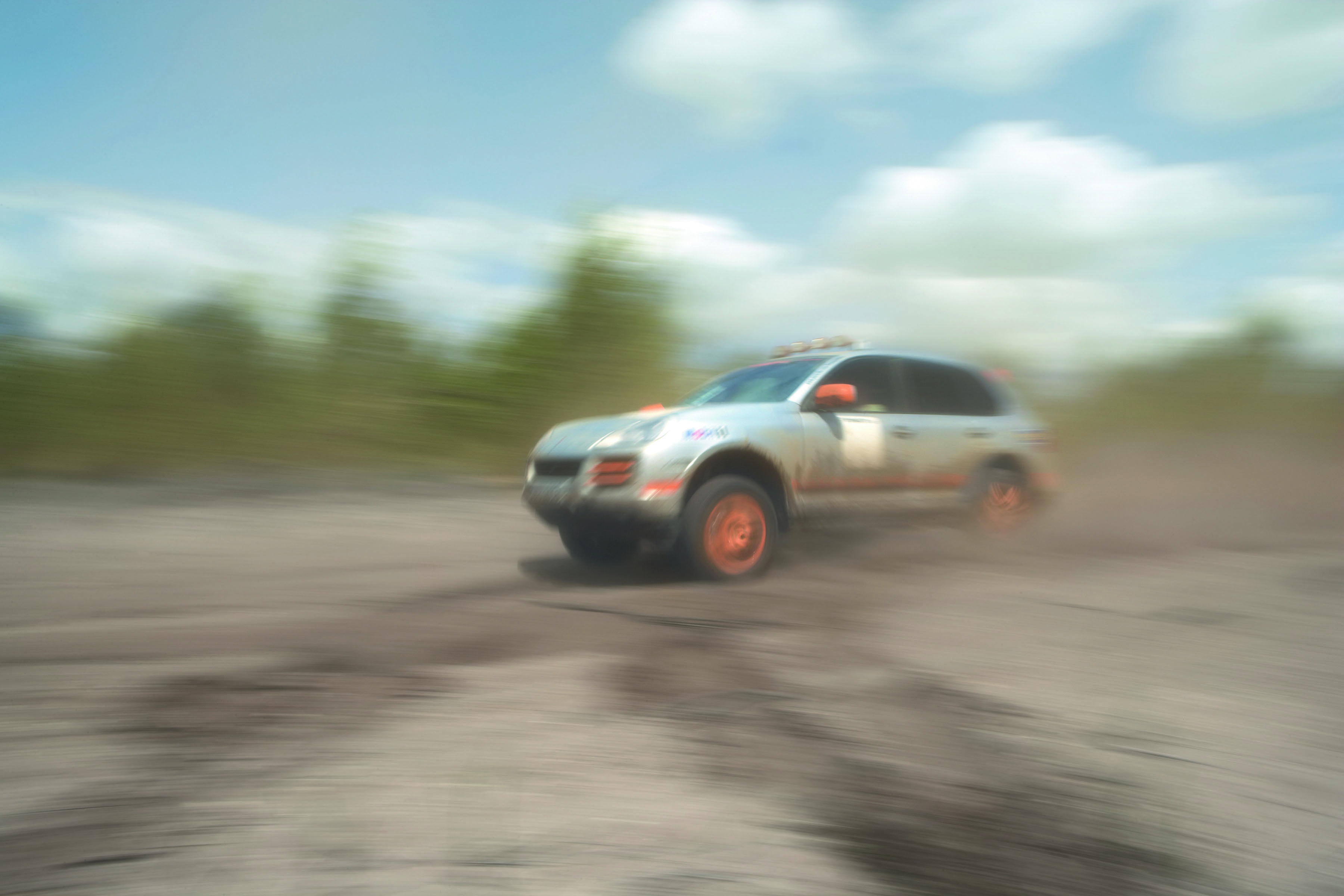
“We can convert this car to a rally version. So we did the Paris-Dakar. The idea was not only to show the people that this car would win Paris-Dakar, but that would also show that it’s a good long-distance car. So we built the 961 for Le Mans. And in the first year, we had placed number seven, behind the very most powerful sports cars. The first race went through with no problem. The second, that was a driver’s mistake. We had an engine with nearly 700 horsepower in the 961 race version at Le Mans.” Bott asked Manfred Bantle to develop the all-wheel-drive prototypes and he tagged Roland Kussmaul to create a group of four-wheel-drive 911s, designated Typ 953, for a series “where prototypes were free to take anything.” Jacky Ickx, who won the Paris-Dakar desert raid in 1983 driving a Mercedes-Benz Gelandewagen, knew Porsche reliability. By this time he had won Le Mans six times, four of them driving Porsches along with hundreds of other wins in 935s and RSRs. He approached Bott with the idea of taking a 911 to the desert. “I thought at the time it could be possible to do it with a 911,” Ickx explained in an interview in 2012. “And the reason was, I saw already a 911 from the East African Safari from 1978. Porsche was doing it at the time with Waldegård and maybe a few others. “When I offered to do it, Porsche was preparing their first integral transmission. That was really a matter of timing. Although Porsche really didn’t want to be involved in the Paris-Dakar, officially, it was a car made in Weissach.

“That car and the three years [after] it were designed by Roland Kussmaul. Because the 911 had to be adapted first to the four-wheel-drive transmission. Secondly, to the specificity of the Dakar. Because sometimes we had stages of 800 kilometers. One of the hardest challenges was to put perhaps over 320 liters of fuel with two spare wheels in a 2-2 seater car. The space is very limited. “After that, we had to adapt it to the surface, so we went in September 1983 in Algeria with a truck and a car, just for development. We went from Algiers to Tamanrasset, at the farthest south of Algeria, on tracks I knew from the Dakar. And every evening we were reinforcing or modifying those things that were not working properly or simply broke. So instead of running around on a short racecourse, we put ourselves in a situation that looked like the race. “We had all sorts of comments at the time,” Ickx recalled, “that it’s impossible for the Porsche 911 to go onto the Dakar. It is not strong enough. It doesn’t have the ability. It doesn’t have a reduction gearbox on it. There were many good reasons. But the vehicle didn’t have much power—I think maybe 230 horsepower, good torque, short gearbox. And light. “I don’t know how much the car weighed but . . . compared to a G-wagen, it was light. Really light. And although nobody expected it, we won the Dakar in 1984. It was not official Porsche because it was a ‘Jacky Ickx team for Rothmans.’ But it was an official entry. And then we repeated that three times in a row . . . . The first one was a success, the second one was a total mess. I damaged my front suspension and I retired. Jochen Mass did a mistake somewhere. And René Metge was leading, and he had an oil leak in the engine and he had to retire. But, in all, René Metge won it. René won three times. I chose him because I thought he could be the perfect solution for a team: experience, talent for the desert, more than me at the time, definitely, and he won it. The Dakar is a race made for the amateurs where professionals can find their place.” While Weissach developed and campaigned the 959s for the desert, another small group of cars mainly intended for rallies and racing appeared, a run designated the SC/RS. Jürgen Barth and Roland Kussmaul had competed in the Monte Carlo Rally in 1983 where they finished 11th behind a rash of Group B Lancia Beta 037s. Group B rules allowed that once a model had been homologated manufacturers could update it each year with a series of no more than 20 evolution models, and Barth proposed that Motorsports “evolve” a group of the G-Series coupes for competition. Designated the Typ 954, the car Barth and Kussmaul developed took inspiration from the earlier 911Rs and they started with a turbo body, retaining its brakes and suspension. They beefed up the suspension, added underbody skid plates, replaced steel panels with aluminum where possible, used thinner glass for the windshield and plastic for side and rear windows. Through relentless effort, they ended up with a 1,984-pound body, some 660 pounds lighter than a production Turbo. The three-liter engine, however, remained normally aspirated, and with modifications for reliability and durability, it developed 255 horsepower at 7,000 rpm. Barth and Kussmaul reasoned quicker throttle response and cooler cockpits were worthwhile tradeoffs, and, with no turbo, the car avoided the FIA displacement 1.4 multiplier with its higher weight requirement. David Richards in Silverstone, England, took six of them to prepare a rally team for Rothmans. Richards’ crews dismantled the cars and reassembled them in ways that expedited in-field service and repairs.

ICKX IN THE DESERT Many racing enthusiasts and most journalists put Jacky Ickx on their short list of all-time greatest drivers. He won F1 races for Enzo Ferrari in France in 1968; Austria, Canada, and Mexico in 1970; Holland in 1971; and Germany in 1972. At Le Mans in 1969, while driving a Ford GT40, he beat Hans Herrmann by barely 100 meters after 24 hours in the closest race anyone has witnessed. The lead changed hands two or three times per lap in the last hour. But it is the desert that became the turning point in his life. “Usually less than half of the people who start arrive at the finish. And already arriving, it’s a goal,” Ickx said. “For those who don’t arrive, the real adventure starts. Because if you are in the middle of nowhere, 800 kilometers away from the first city, when you have a problem with your car, to get it back home . . . ” For Ickx, the sport of the Dakar event was important. But it was not supreme. “When you go far away from any kind of cities, and you go back to the desert, first it’s a fantastic opportunity to discover yourself,” he said. “Because there is some location on this planet, like [for] these sailors who go by themselves around the world, that you can’t lie anymore to yourself. “On that aspect, you feel very small. You realize in a way how unimportant you are. Because you can be whatever you are, famous, not famous, [but] out there, you have your feet on the ground and you realize the nature all around you is totally outside. There is nobody. I think it is a superb lesson of humility. And I think a good three-quarters of the people that do the Dakar are deeply touched by that feeling. “If you ask me what is the best part of my life . . . Formula One, Ferrari, it was really nice and very rewarding. The temptation is to say, well, you are one of the best, and then you know, it’s probably a quality too. You have to be selfish. And you can be nice outside of the car, but you still are a shark in the car. It’s really two different personalities. “The most interesting part, the most amazing part of my life, is this third part, when I went into off-road racing, the discovery of Africa, the discovery of other countries, and other people. It’s what I would call a hundred-eightydegree vision. But what I’m leading to now, with the curiosity, through the Dakar . . . it was the Dakar, off-road racing took me to that view. It was not only sport. It became sport and curiosity. And at the end, only curiosity. Another way of people living.”

Group C remained the endurance series throughout Europe and IMSA provided a variation as its counterpart in its GTP category. Beginning with the 1986 season in Europe, FISA initiated several shorter rounds of racing, 250–275-mile events compared with earlier six- or nine-hour endurance trials. They changed the series title as well, renaming the World Endurance Championship as the World Sport-Prototype Championship. Thereafter, 935s and even 911s of any description almost completely disappeared from entry lists through the mid- and late 1980s. Daytona and Sebring remained the exception, where the massive start lists saw a few old warhorse 935s or RSRs. FIA regulations took effect in 1989, accompanying management changes at IMSA, and these phased out turbos because the costs of cars and annual campaigns forced out competitors. As Porsche had done before with its RSR and 935 models, it withdrew from factory participation at the end of 1988, though it continued backdoor support of Reinhold Jöst’s efforts. In late 1988, the ever-creative Jürgen Barth happened on an inventory of spares from the 1984 Typ 953 four-wheel-drive 911. He conceived an ultra-lightweight Carrera 4, and when word leaked out, customers materialized. To assemble these cars, Zuffenhausen shipped car bodies to Weissach, where technicians fitted thin aluminum doors and deck lids from SC/RS parts leftovers, as well as the simplest turbo whale tail rear wing. Because he executed it as a minimalist homologation model, Barth kept everything out of the car. Even with a twin-plug 3.6-liter engine tweaked to develop 265 horsepower at 6,750 rpm, and with five-speed all-wheel-drive hardware, the car weighed 2,425 pounds compared to 3,200 for the road-going C4 coupes. Known as the C4LB or leichtbau for light body (C4LW in English), Customer Motorsports assembled 22 of the cars. Because no road racing organization accepted four-wheel drive in its classes, the cars trickled out of Weissach through 1990 and 1991, destined for garages of savvy collectors who seized another fascinating Porsche invention when they saw it.

During the same time, Porsche converted the existing 944 Turbo Cup series into a 911 Carrera Cup to promote the new 964 models. Unlike Barth’s C4 platform, this set of cars, executed by Roland Kussmaul and Helmut Flegl, used a stripped C2 lightened to 2,470 pounds with chassis, suspension, steering, and wheel and tire modifications, as well as hyper-tuned engines. The company delivered the first 20 in December 1989, and another 30 followed over the next two months. Kussmaul urged Porsche to keep the series exclusive to Germany initially, simply to satisfy customer demand. The engines, match-tuned for output between 268 and 272 horsepower, were sealed, and the series provided entertaining and closely matched races that supported longer endurance contests. Herbert Linge emerged from retirement to manage the 10-race series. Roland Asch, driving for longtime Porsche racer and dealer Paul-Ernst Strähle, won the championship in 1991. Uwe Alzen followed in 1992, with Wolfgang Land taking the title in 1993 and Bernd Maylander winning in 1994. Porsche allied with Pirelli in 1993 to create a Supercup series for 30 cars that accompanied nine Formula One races throughout Europe. Back in 1991, IMSA had launched a similar Supercar Championship that Bridgestone Tire sponsored. This series put race-prepared series production sports cars from a number of manufacturers in a 30-minute televised race as part of the full IMSA weekend. Kussmaul developed a series of turbos for the series. Brumos Porsche in Jacksonville, Florida, got the first, called the Turbo II, and Hurley Haywood (with Hans Stuck filling in when Haywood had other commitments) won four of the seven races in the series inaugural year. This gave Porsche a manufacturer’s title and Haywood won the driving championship. When Brumos’ exclusive first-year deal ended, Kussmaul shipped a group of cars ready for the 1992 season. As production models, these debuted as the 381-horsepower Turbo S at the Geneva auto salon. Supercar homologation required a small production run, and the S was the next generation of homologation special. Listing more items on the delete pages than fitted options, the car weighed 2,822 pounds. Weissach planned to assemble only 50 examples required for homologation, but demand pushed production to 80 cars, including ready-to-race Turbo S2 models. It proved worth Weissach’s efforts once more, when Haywood and Stuck each took two of the eight wins to earn the championship for Porsche. Driving for Brumos in 1993, Stuck won seven of nine starts to claim both driver and manufacturer titles.

Earlier in 1993, Stuck and Haywood debuted another Kussmaul invention for Jürgen Barth’s customer racing department. This was the 911S LM and it ran a 3.16-liter version of the twinturbocharged flat six that developed 475 horsepower. Kussmaul brutally shaved its weight to 2,200 pounds using extensive composite materials for body panels and paper thin plastic membranes for side and rear glass. At the same time, a normally aspirated 3.8-liter Carrera RSR appeared for entry in the nonturbocharged classes. Each of these was part of the Invitational GT category as FIA’s tentative steps toward making racing costs more manageable during a worldwide recession. Brumos again carried the Porsche standard when Stuck, Haywood, and rally ace Walter Röhrl finished seventh overall and first in the Invitational GT class, ahead of 10 other invitees at Daytona. However, in France at Le Mans in June, the trio suffered an accident in the 79th lap and did not finish. One of the new 3.8 RSRs did win Grand Touring class and it finished 15th overall with the car’s co-inventor Jürgen Barth driving with Frenchmen Joel Gouhier and Dominique Dupuy. A Fabian Roock–entered RSR won the newly lengthened Spa 24-hour endurance race in early August as well as the 1,000-kilometer race in Suzuka, Japan, four weeks later. With 993 pilot production underway, Roland Kussmaul siphoned off a run of 35 cars in May 1993 to convert them into Cup contenders. Deliveries began in November. The 2,425-pound cars ran with engines bored out from 100 millimeters to 102 with 3,746cc total displacement. These 3.8- liter engines developed 305 horsepower at 6,500 rpm. Jürgen Barth took on a new role starting in 1994, as race promoter, independent of Porsche, along with friends and fellow racers Patrick Peter and Stéphane Ratel. BPR created the International Endurance Series exclusively for private owners competing in racing versions of series production GT cars. Tube-frame cars were not permitted. Affordability was the plan, at least until Gordon Murray at McLaren introduced his V-12 BMW-powered F1 GTR in 1995. With a carbon fiber monocoque, a body fabricated from composite materials, and a base price of $1 million, affordability became relative. A year later, for 1996, Porsche responded with its 911 GT1, a 911 in name and facial resemblance only. Rules called for a single road-going example to exist for homologation, and Porsche responded with 993 GT1 Straßenversion, but it arrived almost too late to legalize the racer.

While Daytona had remained an IMSA event in 1995, Barth got the chance at the last minute to join Rob Wollek and Dominique Dupuy in the Jack Leconte’s 911S LM. Despite handling maladies introduced during a practice session crash, the three finished second overall, 24 laps down. Seven of the 3.8 RSRs completed the race as well. Leconte’s Porsche won again at Paul Ricard, at Jarama in Spain, in Japan at Suzuka, and at the season finale in Zuhaï, counting as the first international motor race staged in China.
Previous Page Page 27 Next Page