A new Turbo arrived, delivering 408 horsepower at 5,750 rpm, through all four wheels, hinting at a coming-Porsche philosophy that any of their automobiles providing the customer with more than 400 horsepower was available only through all four wheels. Weissach’s engineers coupled the six-speed manual transmission to a dynamic limited-slip differential with active braking. This was 959 technology brought to a broader audience. The Turbo topped out above 180 miles per hour and reached 100 kilometers per hour from a standstill in 4.5 seconds. A Carrera RS model appeared for model years 1995 and 1996. Fitted with subtle front corner spoilers and a flat rear wing, all in body color, this package for the serious enthusiasts shaved 220 pounds off the standard C2 coupe and engine designers sweetened the package by increasing displacement from 3,600cc to 3,746—designated the 3.8-liter engine. This increased displacement, along with other tricks and treatments, delivered 300 horsepower to some 1,100 customers. Another key to this additional power was an innovative fuel induction system, called VarioRam, that utilized long intake tubes to broaden the torque performance at low and medium engine speeds, and short ones at high engine speeds to produce greater horsepower. Vacuum-operated sliders manipulated all of this technology. The system had debuted a season earlier on the competitionderived GT3 models. An even less common Club Sport package provided slightly closer gear ratios for those intending racing or serious track-day activities. Porsche manufactured only 227 of the Club Sports.
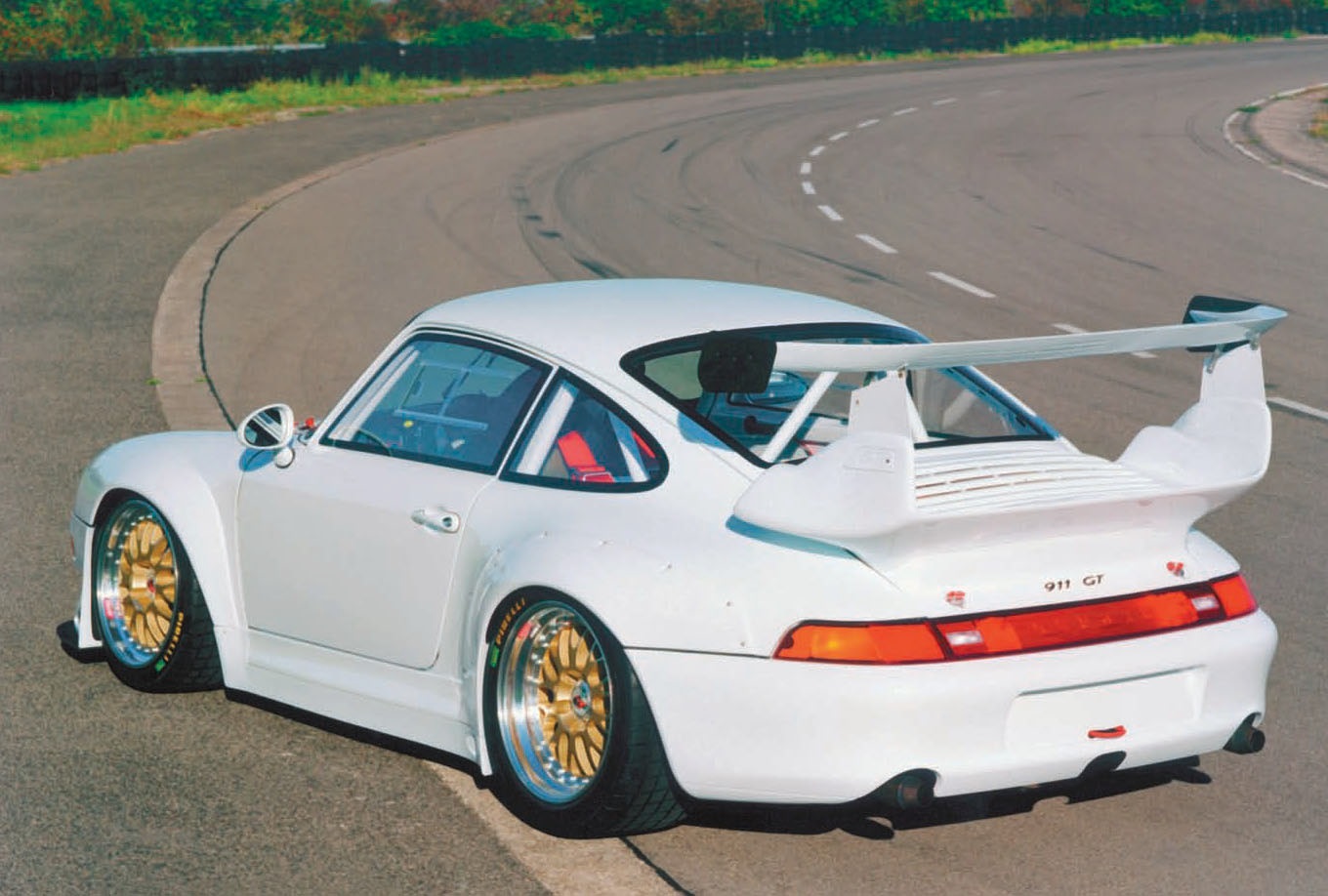
The meanest and leanest of the 993s came in the GT2 model, a vehicle with little pretention and clear ambition for the winner’s circle. Where the standard C2 coupe weighed 3,014 pounds with 285 horsepower for 1996, and the RS Club Sport came in at 2,794 pounds and 300 horsepower (and sold for 164,700 DM—$109,800 at the factory but unavailable to U.S. buyers), the GT2 put 430 horsepower into the same weight (for 278,875 DM—$185,917.) As only 172 of these cars emerged from Weissach’s shops, it was clear, with their plastic wheel arch flares, aluminum doors, and massive three-piece Centerline 9x18 and 11x18 composite wheels, that the GT2 was not intended for mass consumption. VarioRam managed induction on all normally aspirated Carrera engines for 1996, elevating output to 285 horsepower at 6,100 rpm. In addition, the company introduced two new models—a C4S, fitting the normally aspirated all-wheel-drive running gear under a turbo coupe body but using a retracting rear spoiler instead of the Turbo’s fixed wing, and a new Targa, fitted with a large retracting tinted-glass roof. Targa models started life as cabriolets onto which assemblers bonded and bolted a separate roof system.
The opening glass slid back down and inside the rear window. Drivers could open or close the roof at any speed. The Targa was produced on the C2 platform only. On July 15, as assembly line employees prepared for the change over to 1997 model year cars, they celebrated a milestone, driving the 1 millionth Porsche off the Zuffenhausen assembly line. Configured as a coupe with Tiptronic S, the company donated it to the autobahn police of its home Baden-Württemberg region. For the 1997 model year, Porsche offered a Carrera S coupe. This model supplemented the wide-body C4S as its rear-drive sibling, adding the capability of using the Tiptronic S gearbox. Similar to the C4S, the S appeared only as a coupe. Standard normal body C2 and C4 models, in coupe and cabriolet, remained in production. Model year 1998 marked the end of an era of Porsche automobile engineering. Weissach engineers had spent much of the previous decade reckoning with questions of water cooling the 911 engines. Discussions arose repeatedly as the 993 was conceived, designed, and developed. For that model, the costs outweighed the benefits. For the next generation 966, necessities and regulations outweighed everything. As the company prepared to introduce the 996, it dropped the C2 and C4 coupe and cabriolet models from the 1998 lineup. New models of these cars were arriving soon; however, Porsche kept the Turbo, the Targa, and the wide-body Carrera S and C4S coupes in production through this final year. The car that was coming was both the Next 911 and the New Porsche. It projected a subtle change in direction and definition even as it reflected a massive transformation in technology. “ We made the 993 so that we really didn’t need the four-wheel drive. With the new axle, the new platform, the rear engine, you don’t need four-wheel drive, even in Switzerland in the snow. But we went into special markets, like Austria, Switzerland, like Sweden, and they said, ‘We need four-wheel drive.’ They didn’t, but we redesigned the front drive system for the Carrera 4 models for them.” — Bernd Kahnau
EVOLUTION VERSION 2.0
FROM AIR TO WATER THE FIFTH GENERATION: 996 ”In 1991, we had one big problem in the company,” Horst Marchart recalled in an interview in 2012. Marchart had just joined the Porsche board. He had started as a design engineer in the engine department in 1960, and from 1972 till 1988, he served as a leader for external projects at Weissach. In 1988, after Helmuth Bott left, Ulrich Bez pulled Marchart back into Porsche’s mainstream, making him responsible for the complete development for cars. He supervised 350 people. He had watched this “one problem” as it emerged, sometimes seeing it from the perspectives of Porsche’s outside clients. “The 944/968 was an excellent car,” Marchart acknowledged, “but no one said it was a true Porsche. Next was the 928—the original concept to replace the 911. This split the company—one side was for the 911. The other side was for the 928/924/944. It always made a competition inside the company. And outside the company, it was a competition of appearance—the 911 was the true Porsche and the 928 was a Porsche, but not the true Porsche.” When Marchart joined the board, Wendelin Wiedeking gave him the task of solving the one big problem, and the others that grew from it. “We had three products with no common parts,” Marchart said. “My job was to reduce the company to two products with a lot of parts similarities. And it was my idea to use the same face for both cars to give the identification equally. And with the Boxster and the 911, nearly the same from the nose to the front of the doors, we show it is possible for Porsche to build two cars that are both true Porsches.” One more issue had been present from the start. Fuhrmann had attempted to resolve it with his 924 and 928, but it eventually became clear these were not the best solutions to a real problem. “Our next big situation was to stop the air-cooled engine. Nobody in the world had air-cooled engines except us. With all the regulations in the various countries, all that we had to respect, we had these special engines that needed special parts unlike any other manufacturer. We could only have two valves. We needed a special cooling and heating system, different from everyone else in the world. It took a lot of money to make special systems since we could not share technology with anyone else,” Marchart said. He considered making immediate changes. The 964 was ready for release, but among the gasps heard during finance man Branitzki’s suggestion to keep that car around forever were Marchart’s 350 engineers with a much clearer view of coming safety and emissions standards. The development of 993 began even before Branitzki spoke those words. “We made studies and investigations to make the 993 water-cooled. But we had special conditions. We would have needed a new heating and cooling system for a water-cooled engine, and we didn’t have the room in the car body. So we decided to let the 993 stay with the air-cooling and we would start fresh with the next car, the 996. “In the meanwhile, we also had made the studies for a four-wheel steering system, which we liked. But we could find no partners for it. Bosch asked for 60,000,000 DM at that time (about $40 million) to develop the electronics and cooperate with us in development. At that time we had no money in our pockets, so that made the decision to stop that project easy but disappointing. But that was the reason why, in the 993, we had the subframe. We had started to develop the system, and it required the subframe. Then Bosch needed too much. The comfort was excellent. We decided we will stay with the subframe and stabilize the rear axle. And I think it made us the most comfortable 911 ever, in the 993.“For the 996 water-cooled engine, we knew the boxer motor had one problem. The length of the engine is defined with the crankshaft. Not by the cylinders. If you have a 2-liter or 3-liter or 3.5, it is always the same. So when we changed from air-cooled to the water-cooled, the length dimensions came from the old engine. But all other decisions were completely new. As a result, the engine for the normal car was a completely new design. “We had choices. We know that maximum lateral acceleration with our road cars is 1.4 G, maximum. Maximum! And the normal Beetle, for example, 0.8. So we decided to develop dry sump only for the competition cars and for the normal car we had a normal sump and oil pump. The race version was the latest development of the racing engine from Mr. Mezger. Also with the dry sump.” At the same time, Marchart asked Porsche’s procurement people to prepare for him the cost of all the parts in the cars. After long discussions with each development group, he tasked them with determining existing costs and making a cost goal for each part. Most of his engineers told him it was not possible to reduce the costs. Five months later, they had saved 30 percent. He concluded that if it was so easy to reach those goals, they could try to go further. “It became a sport in the entire company to reach these goals,” he said. “We realized that to save our company we had only one chance. I had a lot of problem in Weissach when I came to my colleagues and said, ‘Now we are going to make two cars. One 120,000 DM and the other 75,000 DM.’ I remember one told me, ‘You are crazy. The same parts, the same length, where are we going to find 40,000 DM?’”
It proved to be not so difficult. Both cars shared many of the same parts. He established a production plan of 15,000 to 20,000 911 cars and 20,000 to 25,000 of the Boxsters. He told everyone that the 911 paid the development costs and the investment costs—and the parts costs— while the Boxster paid only for its parts costs. Producing one car in the lineup that shares half its parts with another saves a great deal of money. Marchart has always maintained that this tense period was an exciting time to be at Porsche. For any company, saving 5 percent is admirable. All these ideas saved 30 at the time when the automobile world was rife with rumors that Porsche was about to be acquired by Mercedes-Benz, General Motors, or Toyota. “So the basic idea when I made this proposal was we need 3.5 billion [DM] turnover [revenue] with our cars. And the basic car in Porsche could only be the 911—at that time. Because it was the heart of the company. The possibility was if we went to a higher car, it is expensive. So if you set a production number of, say, 20,000 cars in the year, well, 20,000 cars a year in this existing company means 50 percent of the people we must fire. So you must have in the minimum 35,000 to 40,000 cars to produce that turnover. So I said we must have a car under the 911, cheaper than the 911 to bring up the production numbers. And also we bring in younger people who will look up to the 911. “The next question was then how do we find the way for the second car to give the image that it is a true Porsche. I’m not sure how many Porsche drivers are really sports car drivers. A lot of them are really image drivers.” In many ways, Marchart’s concept had a ruthless economy to it. Even with the 911’s rear engine (and the Boxster’s mid-configuration), more than half the parts and costs in the car exist between the front bumper and the driver’s seat: front impact safety (and the expensive crash tests), fuel tank, heating/air conditioning, steering, suspension, instrument panel, entertainment systems, main operational computers. . . . The list is staggering in its quantity, costs, and complexity. To standardize two cars with one set of these elements saves a fortune. Making two cars with the same front structure and infrastructure alone would have proven economical. But everyone got to weigh in.
Production engineers wanted to shorten assembly-line time and decrease the number of processes, procedures, and actions for each assembler. Someone set a goal of no more than 20 seconds for mounting, installing, and connecting the low- and high-beam headlights, fog lamps, parking lights, and turn signal on each side of the car. Not even a robot could accomplish five fixtures in 20 seconds. As a single subassembly, it was possible. But this meant using the same lighting module in two models. If headlights are a significant part of the “face” of the car, making two cars with the same face was a radical product-planning concept as well. For chief designer Harm Lagaay, it presented huge challenges. The least of them was enlarging the studios because Marchart’s concept meant two designers had to work side by side. A flash of inspiration from one designer meant the second car had to change identically. Instead of a 911 studio and a Boxster studio down the hall, there were a series of teams of designers working on each team of cars, all in a competition with each other to create the appearance that will capture the audience. Lagaay knew his staff. Some he inherited from Lapine, some he brought with him from BMW, and some he hired himself. He knew their personalities and he carefully gauged his pairings. He had nearly a half-dozen teams working on concepts for the two cars. As important as knowing his staff, Lagaay had an idea what he wanted. This helped him direct and encourage his teams so each pair of proposals reached the same level of style, sophistication, and Porsche-ness. The design director may never touch a pencil to paper, shave a millimeter of modeling Plasticine, or input a single keystroke into a CAD/CAM terminal anymore. Their job is to direct, to manage the imaginations and ideas of their staff and of each team with a word, a hand gesture, a literary or music reference. Designers and board members had become more polished, with higher expectations. While the board expected to be asked its opinion and for that to carry weight, it also wanted direction. No longer could Erwin Komenda redraw and resize seats in front of the decision makers and then ask, “Which do you take?” That was a time of development not only in design and materials but also in presentation. The process had become more like what F. A. did with his father: “We did these and these. But here: This is it.” The winning design came from Pinky Lai’s concept for the 996 and Grant Larson’s for the Boxster. It is a familiar story: in the midst of the stress of a tight economy and new car development, CEO Arno Bohn asked Lagaay to produce a show car, something to excite audiences and show them Porsche still was around. Lagaay tagged Grant for that assignment even while Larson worked alongside Lai developing the production cars.
Steve Murkett christened Larson’s sporty Boxer-engined roadster the Boxster during a design staff meeting, and the car’s positive review before the board put it on an airplane to the North American International Auto Show in Detroit in 1993. By the time it appeared, Bohn was gone and Wiedeking was in his place. When the chairman pulled away the cloth in Detroit, it had the effect of putting the car in front of the public and saying, “Here, this is it!” The media and enthusiast response energized Lagaay’s exhausted design teams. He reached Lai by telephone in a wind tunnel where he and modeler Eberhard Brose were struggling to make aerodynamics work on a car that could not afford an electric rear spoiler anymore. Yet the company could not afford a new roofline that would solve the conundrum without changing the fundamental—and necessary—silhouette of a 911. Lai went back to work, Lagaay worked on the chairman, and Wiedeking found the funds to electrify a rear wing.
PREDEVELOPING THE 911 The development work on the 996 was far from finished and for every few thousand DM that Wiedeking released, there were other ideas, improvements, and upgrades that didn’t make the cut. Soon after Ulrich Bez arrived, he overturned or overruled many of the ideas, goals, techniques, and procedures that Helmuth Bott had kept in place for many years. It was one of several actions that did not endear him to Weissach staff. But one good thing came from the Bez revolution. The company established a predevelopment department. In essence this was a kind of practical and theoretical experimentation group that looked into new or alternate technologies and materials that might be useful to Porsche. Hans-Peter Bäuerle was part of that group. “Because I had still been working in lightweight materials, in aluminum, with space frames,” he said, “they gave us the responsibility to see if aluminum space frames would be suitable for the Boxster and the 996. Eugen Kolb was working in this predevelopment department with me. We worked together on this space frame, using aluminum profiles.” “We had the idea to make the floor of a car without any welding,” Bäuerle continued. “Because if you put heat into aluminum, it is not so good for the durability. I think Kolb has the patent to clamp and glue the entire 996 floor panel. We even built prototypes, not running but hydro-pulse prototypes— I think there were five or six we made. “Then came Mr. Wiedeking and he looked at it. ‘Good looking. Good technology. But too expensive.’ I must admit, it was his job to save the company. I understood the decision to make the Boxster and 996 in steel technology, but where we put our ideas in place, we used not just normal steel but high-strength steel—in a high amount. In those times we had more than 50 percent high-strength steel, which no other manufacturer was doing. “I got a lot of people laughing at me. ‘Wow, warm-formed steel! You are crazy!’ We had a special design of the firewall of ultra high-strength steel so the Boxster and the 996 had a very good ratio between strength and rigidity, nearly double the rate of other cars. Very good crash performance. In the 911 it always has been important to keep the tank from the passengers, also to save intrusion in the leg area. We saw that we could realize a high intrusion protection.” It made for a stiffer pair of cars than Porsche had achieved before, improving road holding and handling as well as passenger protection.
The cars, by necessity, grew heavier, if for no other reason than the addition of 20 liters of cooling water, the radiators, pumps, and plumbing. Ironically, as Lai struggled to control aerodynamic lift at the rear of the car, he raised the rear profile. This provided engineers the extra room they needed to accommodate the slightly larger engine. The wheelbase grew 3.2 inches to 92.6 and overall length gained 6.8 inches to reach 174.5. Front and rear track widened nearly 2 inches while the body width grew an inch. The new engine displaced 3,387cc, with bore and stroke of 96 millimeters by 78 millimeters. By eliminating the air-cooling fins, the design engineers had room for four valves in the heads and they returned to a single spark plug ignition. This combination gave them 296 horsepower at 6,800 rpm. While the water cooling muffled engine sounds somewhat, engineers fine tuned intake and exhaust manifolds for the sound they produced as much as for flow efficiency. “The 996,” Bernd Kahnau put in perspective, “was the car for everyone who said they wanted a sports car but didn’t always want to have sports car noise.” Water cooling also greatly improved heating and defrosting. Getrag and Porsche collaborated on a new six-speed transmission that could accommodate much more power than the new engine produced with an eye toward down-line development. The Tiptronic S transmission provided five speeds. Zuffenhausen began series production of the coupes in early fall 1997 as a 1998 model for Europe. Cabrios followed a few months later. Porsche Cars North America launched both models simultaneously in mid-April 1998. However, because all these introduction dates came more than a year after the Boxster had appeared, an unanticipated and unfortunate impression fell on some customers and observers. Everyone recognized that the 996 was the company flagship, yet with the same face on two cars, some people got the sense that it was the overpriced upgrade of the entry-level model. Once they drove the car, however, there was no mistaking its potential.