The Typ 901 designation—for the new eight-bearing four-cam engine and the complete car— first appeared in Porsche’s internal documents on January 9, 1963. The engine developed 130 net horsepower using DIN (Deutsches Institut für Normung) standards and 148 gross, according to SAE (Society of Automotive Engineers) calculations. Adding the dry sump did not necessitate a major Typ number change. By October 30, according to Aichele, engineers inside the company knew that Typ 901 engines “intended for production will be numbered sequentially beginning with the number 900 001.” That memo stated that engineering had reserved the first 100 engines for its own testing purposes. As Aichele learned, “The 901 prototypes were based on so-called replacement bodies, with chassis numbers beginning with the number thirteen. The first 901 development car,” he reported, “carried chassis number 13 321. Engineering numbered these forerunners sequentially only up to the tenth car. The eleventh, numbered 13 352, fell out of the sequence. The twelfth test car, numbered 300 001, bore the first production serial number.” Activity in Zuffenhausen was frenetic. Helmut Rombold’s rack-and-pinion steering system went onto the new car. ATE disc brakes, introduced on the contemporary 356C and SC models, came over as well. New independent front and rear suspensions improved handling and provided greater space within the 901 body. The nomenclature emerged from a worldwide parts-distribution and sales pact between Volkswagen and Porsche. The only available sequence of numbers that was large enough to handle a new Porsche model began with 900. Porsche’s neighbor Reutter, having helped in development of the new 2+2, balked at the expense of producing new tooling to manufacture the body panels and constructing new facilities to assemble the cars. Company founder Wilhelm Reutter had died in 1939 and his son Albert, who ran it after that, died in wartime bombing in Stuttgart. Walter Beierbach had managed the company successfully, but, when the family faced the financial commitment to produce Porsche’s new car, they chose instead to put the company up for sale. Ferry had no choice; Reutter had helped develop the new car and they knew too much about Porsche’s business. He invested six million Deutschmarks (DM)—nearly $1.5 million at the time, more than $11.4 million today—to acquire Reutter Karosserie. The new Porsche improved on the 356 in many ways. Fritz Plaschka’s “big line” roof provided 58 percent greater window glass area. The wheelbase, stretched only 100 millimeters (3.9 inches) from the 356’s 2,100 millimeters, and better but more-compact suspensions provided nearly twice the interior and front luggage capacity. Ferry’s aerodynamicist Josef Mickl reduced the coefficient of drag from 0.398 for 356 models to 0.38 for the new car. Running prototypes finally appeared on the roads around Zuffenhausen in March and April 1963. Ferry’s investment in the new car was approaching 21 million DM (more than $5.25 million at the time and nearly $40 million in today’s dollars), including the Reutter acquisition. It presented a staggering risk. Ferry debuted the 901 at the IAA international automobile exhibition in Frankfurt in September 1963. The car provoked enormous interest. The IAA opened in Frankfurt on Friday, September 13, 1963. Journalists got in as early as Tuesday evening, the 10th, and briefings introduced new cars to writers and photographers through Thursday. Auto show records reveal that 21 manufacturers debuted models during the 1963 exhibition. Mercedes-Benz showed the closest competitor to Porsche’s new car with its 230SL. Further out the engineering spectrum, both Rover Cars of Britain and NSU of Neckarsulm introduced startling new powerplants: Rover showed off a gasoline turbine and NSU displayed its first production Wankel rotary-engine models. Autos alternated with trucks at Frankfurt, the commercial vehicles filling the hall in even-numbered years while the odds went to automakers. In hall 1A, at stand 27, Porsche had rented 211 square meters, about 2,265 square feet out of the entire show’s 800,000 square feet. Surrounded by an Emailblau 356C cabriolet, a Togobraun SC coupe, and a Signalrot Carrera 2 coupe, the company introduced the 901, displaying its fifth prototype, No. 13 325, in a special blue paint. It was reported to be Ferdinand Piëch’s test car. Attendance records indicate that more than 800,000 visitors wandered the Frankfurt show halls over the next ten days. Porsche sales director for Germany, Harald Wagner, knew that delivery of the first production model was a year away. He encouraged his staff to make that delay clear. Despite this and its respectable price of 23,900 Deutschmarks ($6,020 at the time; about $45,000 with inflation at the end of 2012), and the fact that no drivable models existed for road tests, Porsche banked some sales deposits for the new car. (The price fluctuated between Frankfurt and the end of the year as specifications and standard equipment evolved.) This called for 7,000 DM ($1,755) up front, and it came with a promise that Mr. Wagner’s staff would send a letter notifying the buyer when they could pick up their new car. At the same time, nearly 400 loyalists placed orders for 356 models.
VON HANSTEIN’S ADVENTUROUS PROMOTION It hadn’t hurt Porsche’s cause at all that the company’s charming and shrewd press and racing director Huschke von Hanstein had stirred the waters in advance of the introduction of the 901. Von Hanstein was a regular reader of Auto Motor und Sport, the Stuttgartpublished enthusiast magazine circulated throughout Germany. Early in 1963, he saw photos published on the contents page that showed a new Mercedes-Benz 600 Series model testing on public roads. It generated a great deal of attention. Helmuth Bott’s engineers had created camouflaged versions of the 901 for nighttime testing, and Von Hanstein and Bott arranged for one car— nicknamed der Fledermaus (the bat) because of its two finlike wings on the rear deck—to be captured on film by a friendly photographer. Porsche Archiv director Dieter Landenberger explained that Von Hanstein himself delivered the prints to the magazine, along with the kind of information about the prototype that no spy photographer could know. Alongside the headline Abenteuerlich, the German word for adventurous, or even bizarre, a series of photos credited to Blumentritt in the July 27, 1963, issue whetted the appetites of Germany’s enthusiasts.
While only Helmuth Bott’s test drivers had accumulated any time in the new cars, the enthusiast magazines praised the 901 based on its appearance and specifications. Buoyed by positive feedback, Ferry prepared for the Paris Auto Salon, from October 1 through 11, a month later. He felt some relief at last. He still had millions of Deutschmarks to earn back, but internal battles over body style and the questions of usable engines were settled. Conflicts seemed a thing of the past. The French were loyal customers. He anticipated a good reception. There, visitors and journalists loved the car. However, the reaction from a fellow manufacturer was decidedly less warm. Automobiles Peugeot had registered with the French office of copyrights and patents the right to designate their models with a three-digit number that placed a zero in the middle. The first such use came with their Model 201 in 1929. By 1963, the sequence had gone as far as 403, 404, and 601. During the Paris show, Peugeot notified Porsche that it could not call the new car a 901 in France. Huschke von Hanstein, still in Paris, sent an urgent note to Ferry on October 10. France was a good market for Porsche cars. Ferry felt there was little use in reminding Peugeot that his 804 Formula One car had won at Reims the year before. In a rush of memos between Ferry, von Hanstein, and Wolfgang Raether, they contemplated renaming the car the 901 G.T. That idea died when it became clear there was no room to insert the two letters into materials ready for printing in German and French. On the other hand, with the three-digit Typ number appearing throughout any text material, changing the middle was relatively easy prior to mass printing.
On receiving Peugeot’s letter, Ferry halted production of brochures and the cars. Rather than antagonize an entire nation, he made his decision on October 13 to renumber the car as the 911 for all its markets effective November 10. Porsche had begun 901 manufacture on September 14, interrupted it on October 10 as they dealt with Peugeot and awaited their response, and then resumed around November 9. By this time, barely a dozen cars were complete. One went to Franz Ploch and Werner Trenkler for a cabriolet experiment and then on to Karmann; two cars—300014 and 300016—went to Paris distributor SonAuto for the Paris show, one for display and the other for demonstration, departing Zuffenhausen three days before the show opened. Porsche shipped another to Japan (300022) for an exhibition and still another to California (300012) for an automobile display near San Francisco. Perhaps only one or two cars slipped out to early customers in late September. The rest of them simply got rebadged as 911 models. The process to create the new Porsche had taken up more than a fifth of Ferry Porsche’s life. He turned 55 on September 9, five days before 901 production commenced. During that time, he directed his company through three evolutions in his 356 series, and he had worked with outsiders successfully—Drauz, Karmann, D’Ieteren Frères—and others less so. His racing programs evolved from the 550 Spyder through the 718 open and closed cars, and in and out of Formula One. It’s likely that Ferry truly believed his statement about the “shoemaker, stick to your last.” It held true for racing; while the Abarth GTLs were not perfect cars, they won races, and their successors, the 2000 Carrera GS Dreikantscheibers and the conquering 904s, proved that Porsche is the roadracing company. It was a highly eventful period of time, including the costly and unexpected acquisition of a neighbor he had hoped would simply remain a partner. The roots of the first 356s clearly were engineering and technology derived from the Volkswagen. Through their own era, they evolved into vehicles purely Porsche. The 911, and its entry-level sibling, the four-cylinder 912, drew not only a line in the sand, but also etched a demarcation point in automotive history books. These cars began as Porsches, supervised in design, engineering, and manufacturing by F. Porsche and F. Porsche Jr. In some ways, it scarcely matters who drew what line on what date. A former Porsche stylist who now heads another automaker’s advanced design explained it recently: great design is accomplished as much with adjectives and metaphors as it is pushing a pencil. It requires good taste and good judgment. It has a final editor who has the executive authority to say, “See! That’s it.” The company delivered the first 901s on October 27, 1964. No one alive at the time imagined what was to become of the cars and their work.
“ It was my father’s wish that I get to know the car body division and simply gather knowledge ‘from scratch’ with the people there and work together with them. I knew Mr. Komenda and Mr. Reimspiess from my childhood, dating back to Gmünd and the old Stuttgart days before the war.” — F. A. Porsche
EVOLUTION VERSION 1.0
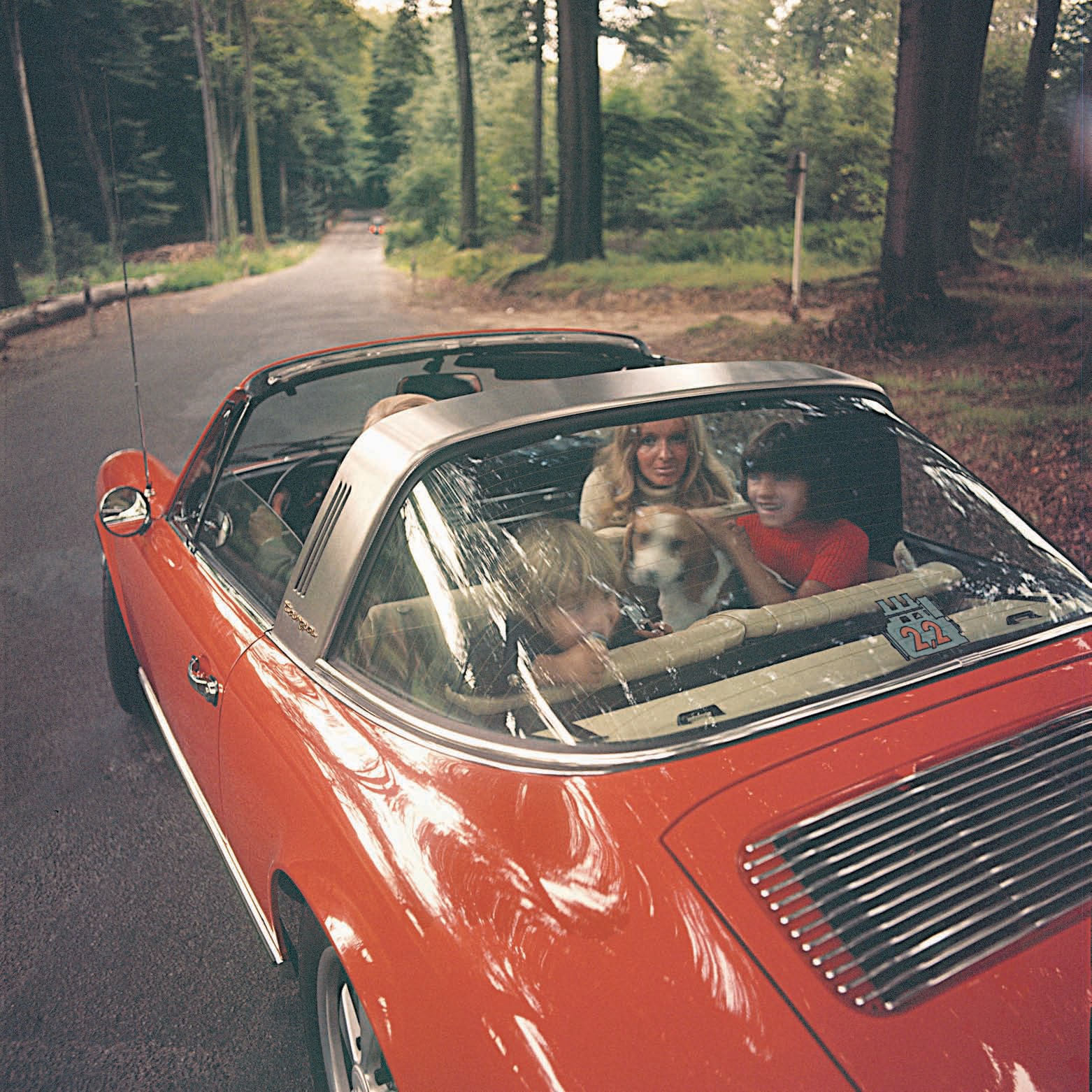
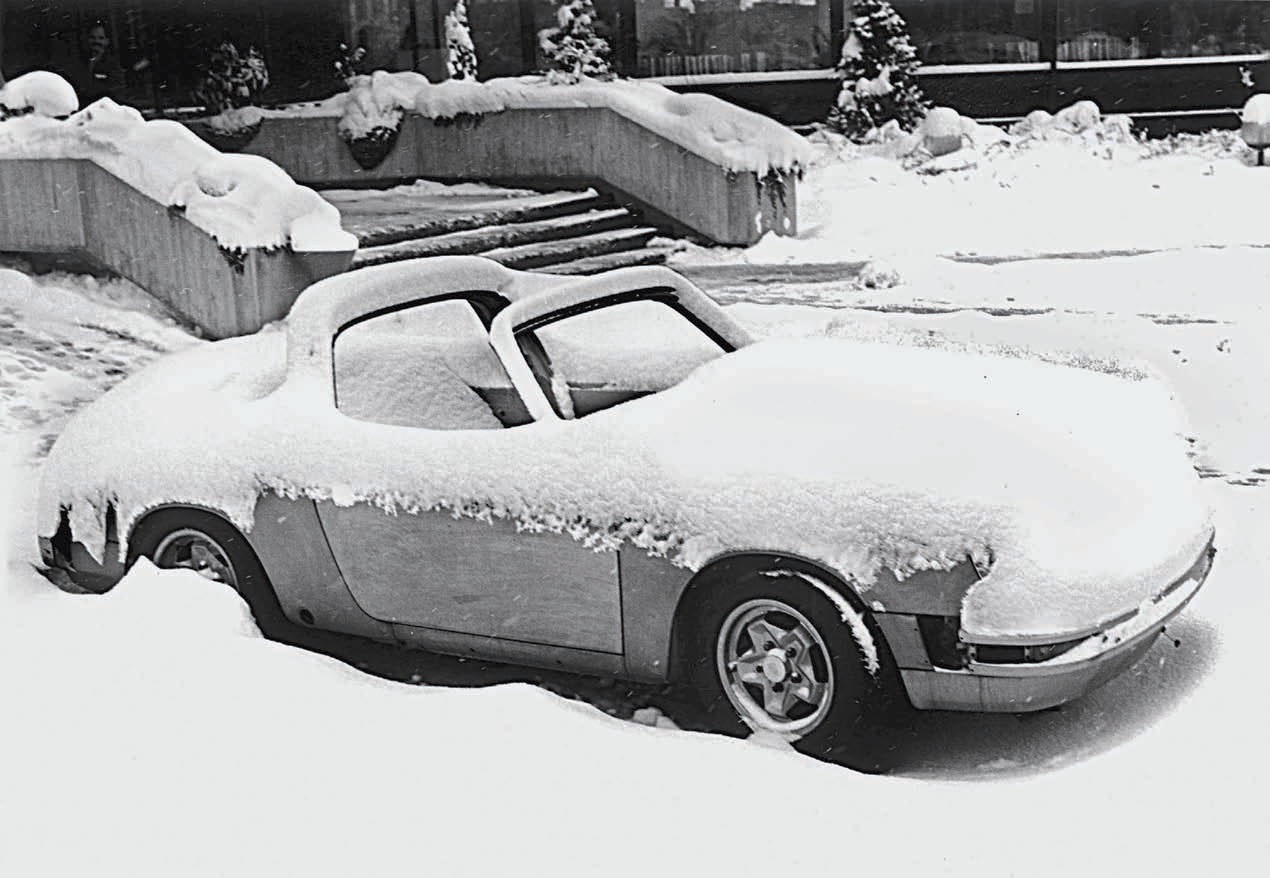
Throughout the ascent of design Typ numbers from 695 to 754 to 901, Ferry remained committed to offering an open version of the new Porsche. F. A., his designers, modelers, and engineers had submitted three scale drawings and a model to Ferry, who followed up this review with a letter he wrote to Karmann in mid-October 1962. Karmann assembled the 356C and SC cabriolets and was the natural one to field this inquiry. Ferry asked the manufacturer to evaluate the concepts, which included a cabriolet system similar to the 356 configuration with a padded top, a clear plastic window removable by zipper, and a boot that hid the roof and stored it as low as possible in the car body. The second option was a collapsible top that required unsnapping the cloth material for stowage beneath the boot. The third version described a main top bow housed inside a rollover bar with removable top and rear panels. F. A. also had proposed a rigid but removable steel roof. Still other concepts followed, including one that described a collapsible and/or a removable rollover bar. Perspectives differed on the look of the roof and the profile of the car, top up or down. F. A. told Aichele that he preferred that “the open car should have a distinct feeling in the roof line, to underscore the Roadster feeling.” He offered a drawing in early December 1963 that showed this idea. It was not as severe as the “stepped roof” variations Erwin Komenda had made five years earlier, but it showed a definite, gentle break in the roofline behind the rear window. The roadster concept, however, brought up problems with the entire idea of an open car. As Eugen Kolb pointed out, “No one considered the cabriolet during design of the coupe. It was talked about but forgotten when the other discussions were going on.” Whether a rollover bar collapsed or a soft top folded into the rear of the car, there was no place to put it. One version completely sacrificed the rear seats for the top, its bows, and the rollover bar storage. There were other considerations. Although that recent evolution from an engine with two smaller cooling fans mounted over each cylinder bank to the Typ 901/1 with its single larger one certainly had improved engine performance, smoothness, and reliability, it had yielded one unanticipated consequence. Where Komenda’s 356B Hardtop Coupe had increased interior room for the 356, the B Roadster’s alternate bodyline reduced the space even when the top was raised. Lowered, it proved impossible to store any 911 top proposal because of the taller engine and the chassis parts. “Drawing the cabriolet, the system to open the roof, the kinematics, was not right,” Kolb explained. “The system for the 356 was completely developed, but nothing could be taken from it for the 901. If you had copied the 356 roof system, it would have been too high at the rear, like a Volkswagen, not like a Porsche.” Kinematics studies the mechanics of the motion of a body or bodies—in this case, the cloth top and support bows of a convertible roof—without considering its own mass or forces acting upon it. Most crucially, the estimated costs of designing, developing, and making stamping molds for new sheet metal for this 911 roadster body killed any chance. “ Drawing the cabriolet, the system to open the roof, the kinematics, was not right. The system for the 356 was completely developed, but nothing could be taken from it for the 901.” — Eugen Kolb After the September IAA debut, however, pressure increased. Sales boss Harald Wagner reported that many visitors asked about an open version. Over the next months, development continued on more concepts until early June 1964, when a prototype “open car” emerged from the shops. Gerhard Schröder remembered that Franz Ploch and engineer Werner Trenkler had gotten a car to work on. They also had done cabriolet development for the 356 models. By June 12, he and engineer Werner Trenkler had completed their first mockup, and Ferry had it photographed that day. Barely two weeks later, on the 24th, a group convened to review the car. Ferry Porsche, F. A., Hans Tomala, Hans Beierbach (now running Reutter for Porsche), Erwin Komenda (whom Ferry had put in charge of completing the 901/911 technical drawings), Fritz Plaschka, and Harald Wagner (Ferry’s sales chief) examined the car. Trenkler and Schröder were missing from the review. This was a case, Schröder explained, where those asking the questions asked the wrong people. Had he and Trenkler been present, he said, the story might have a different ending. Wagner argued vigorously for the fully open car, expecting it to sell at least as well as 356 cabriolets had done. Ferry listened as Beierbach and Komenda stressed the extensive work and the expenses Porsche might incur stiffening the chassis and revising the rear body panels to accommodate the soft top and its supporting bows. Ferry concluded that it was too costly, deciding instead to approve the roll-bar variation. However, it, too, needed some changes. “There were so many obstacles,” Kolb continued. “Of course, the car lost much of its stiffness. The cabriolet proved the 901 chassis was not strong enough.” One further consideration affected Ferry’s reluctant decision to let the cabriolet slip away: By this time, automobile safety advocate Ralph Nader in the United States had drawn a growing audience to his objections to vehicle design and engineering. Inside Porsche, engineers, designers, and marketing staff worried that legislators in its largest market might outlaw convertibles altogether.Soon after this, Ferry asked Karmann in Osnabrück, who did not respond to his first inquiry, to work further on an open 901. Porsche shipped them the Ploch/Trenkler prototype, 13 360. When that car returned to Zuffenhausen on September 10, 1964, it entered the system with a Cardex that showed the date, its number, and its specification as a Typ 011/KW, Cabriolet, a designation that modern-day engineers suggest may have been intended to disguise its real purpose. A few days later, Porsche started 901 production, on September 14, beginning with serial number 300 007 (oddly, Porsche did not assemble number 001 until the 17th). With production startup problems occupying his time and energy, it wasn’t until late in January that Helmuth Bott took a long evaluation test drive in 13 360. He paid particular attention to chassis stiffness (which, after Karmann’s work, he found no worse than the 356 cabriolets he had driven), and to the soft rear window flapping and fluttering. A few days later, testing the car with the removable roof panel in place, the wind noise was so great he could converse with a fellow engineer only by shouting. There was work to do.
“ There were so many obstacles. Of course, the car lost much of its stiffness. The cabriolet proved the 901 chassis was not strong enough.” —Eugen Kolb