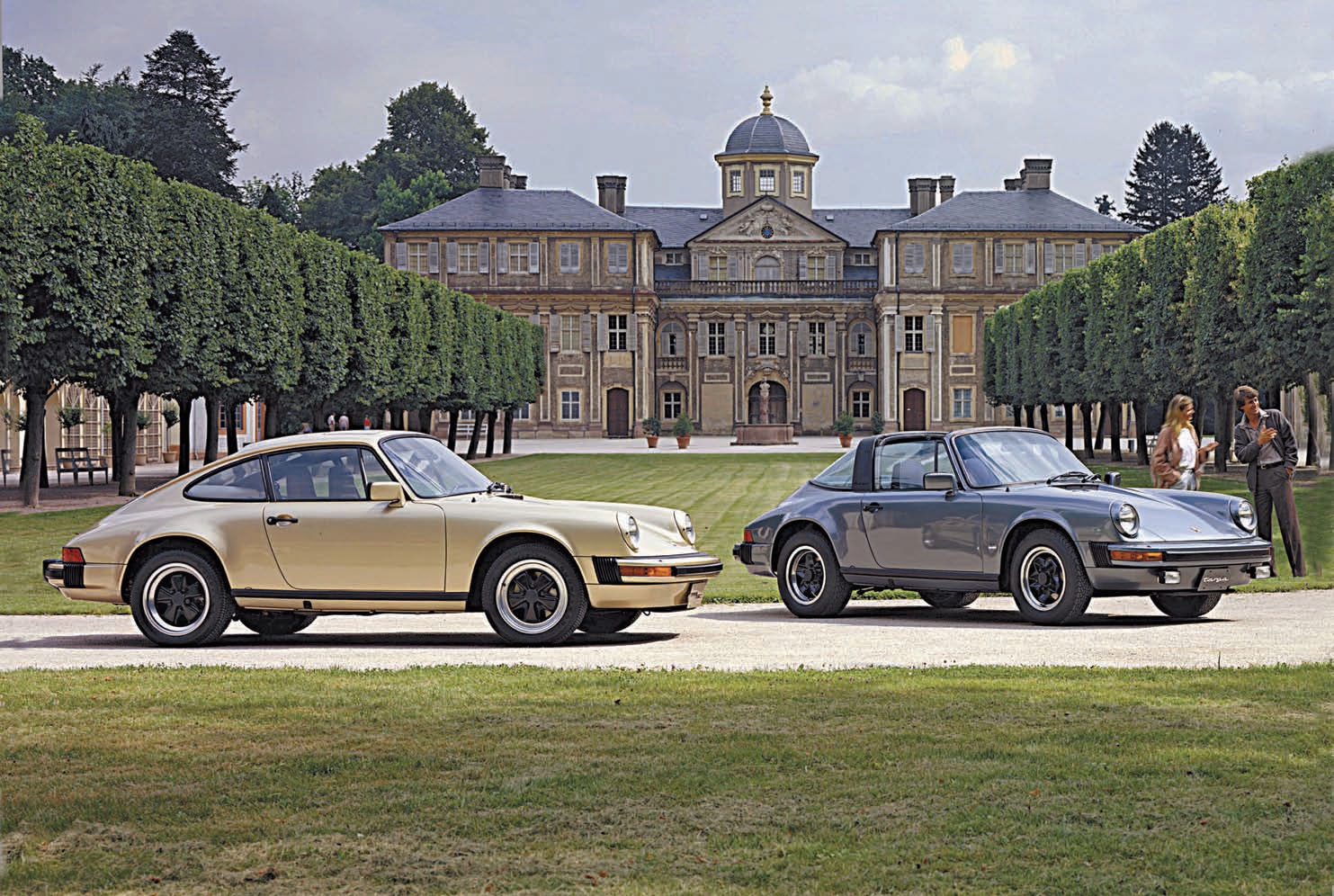
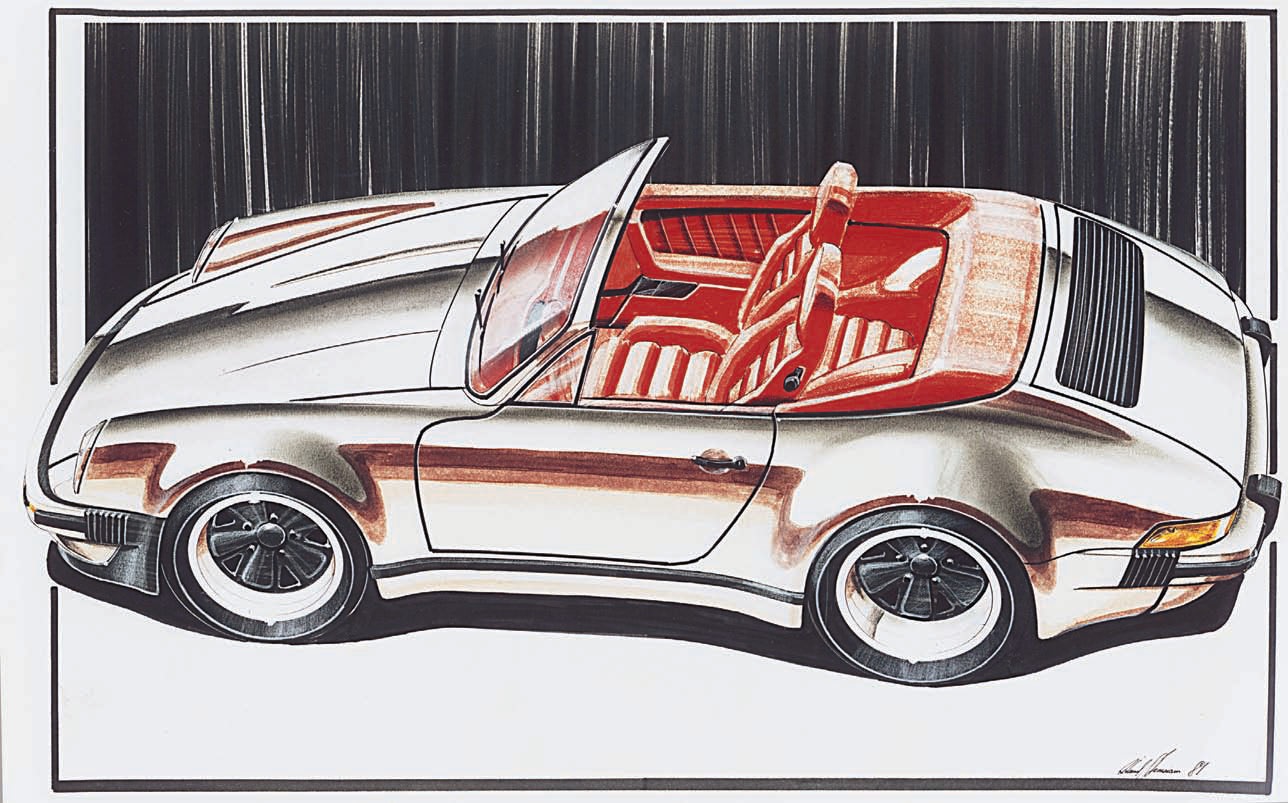
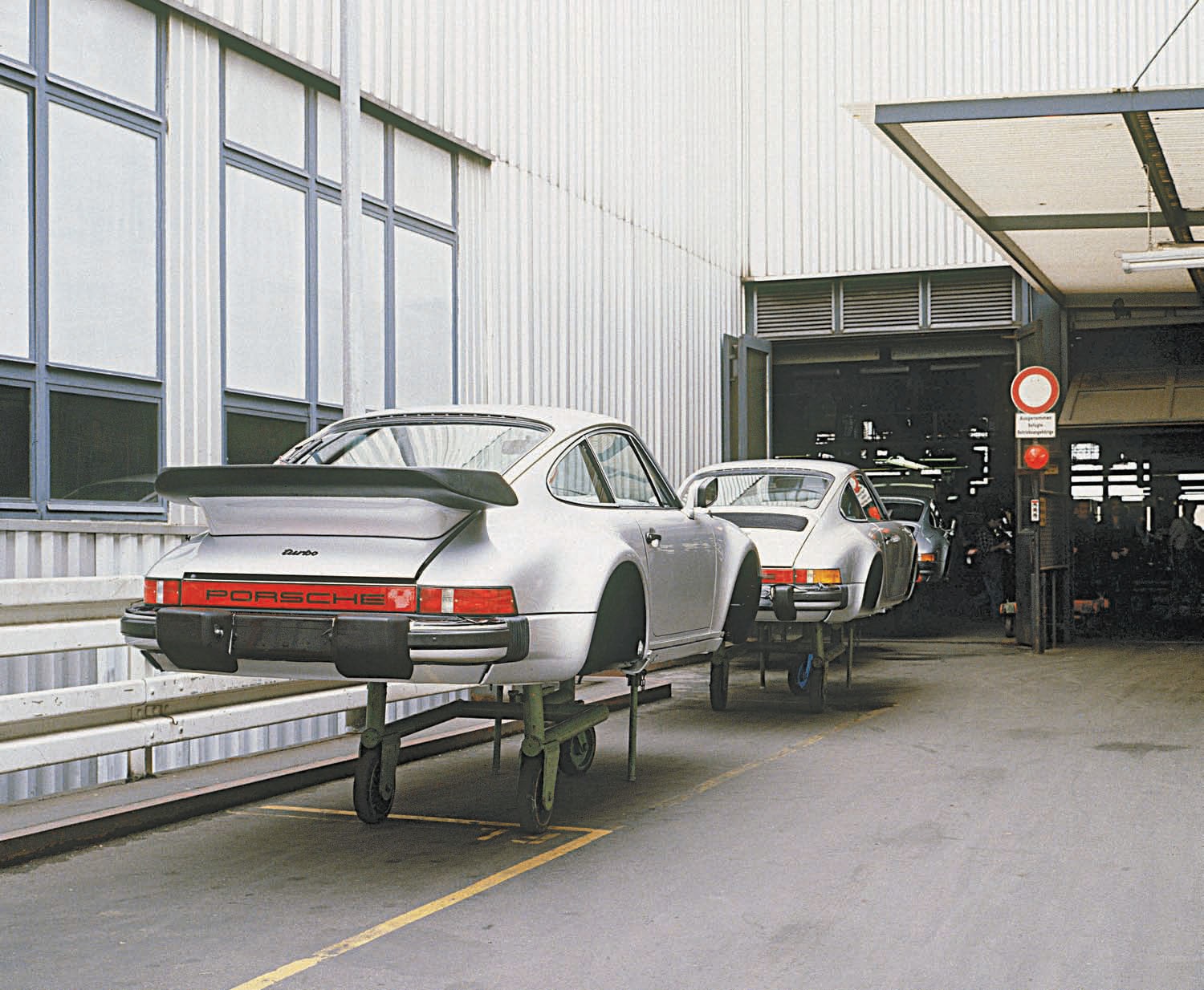
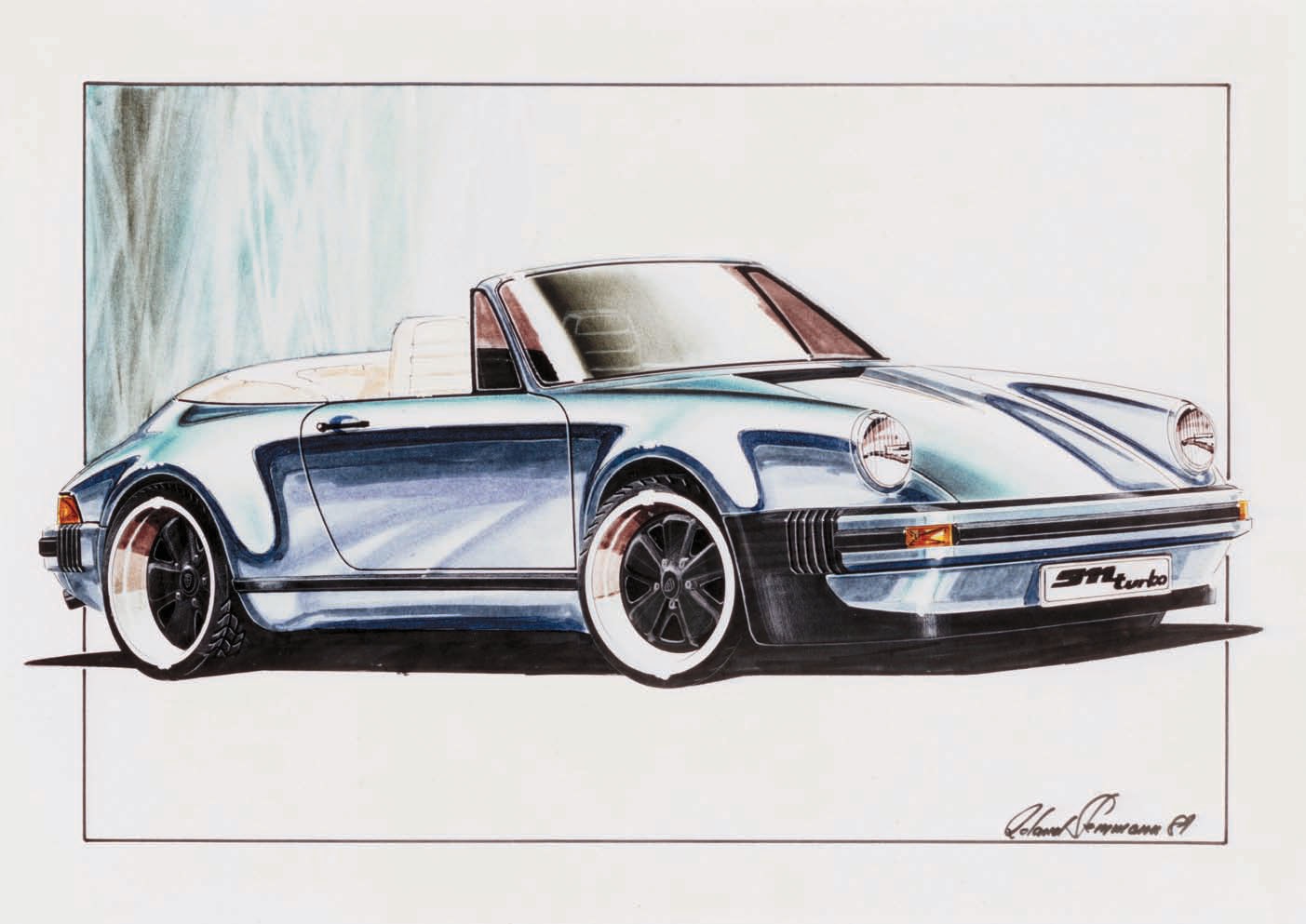
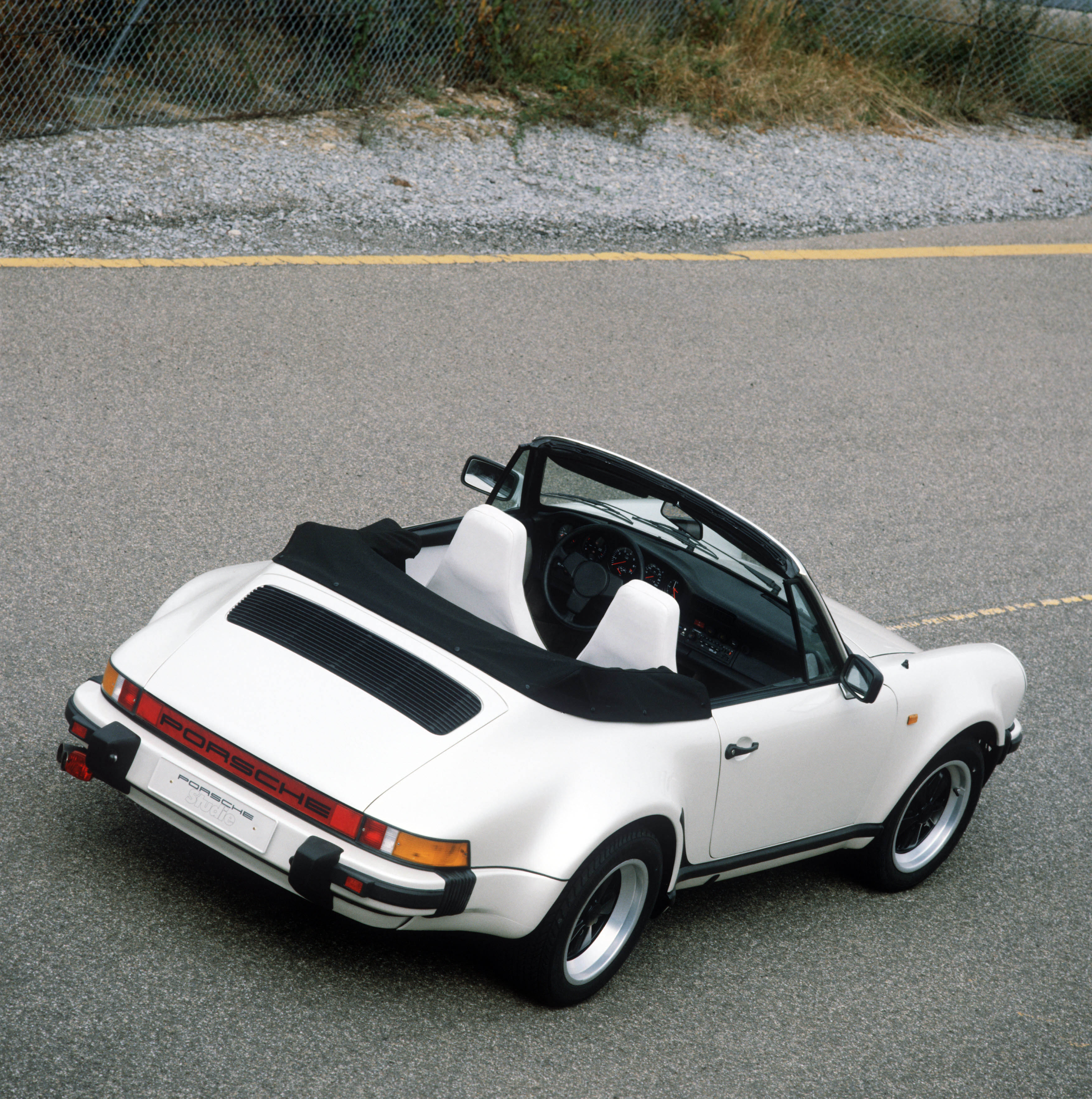
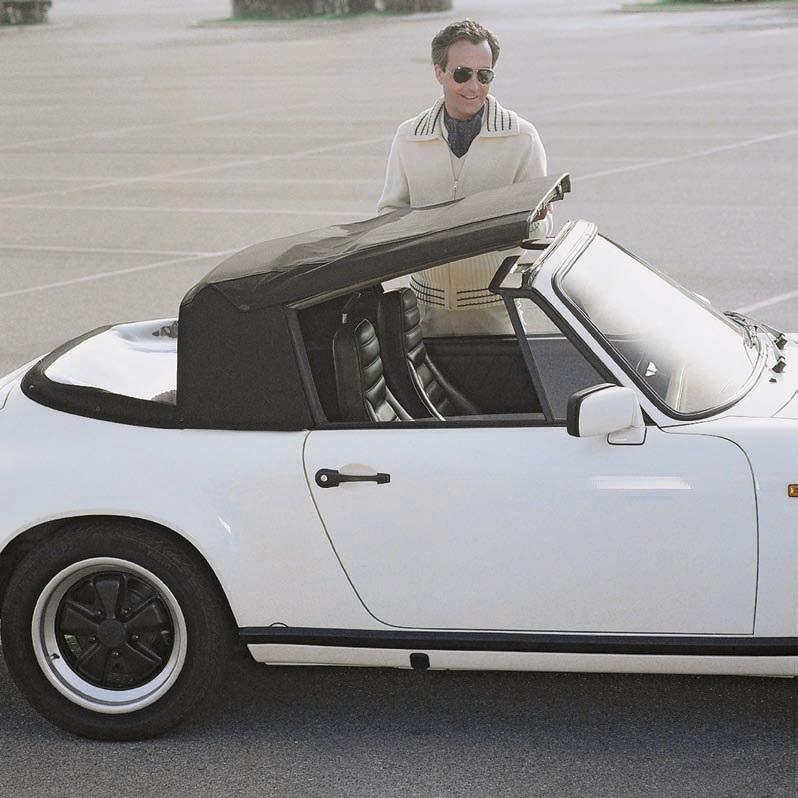
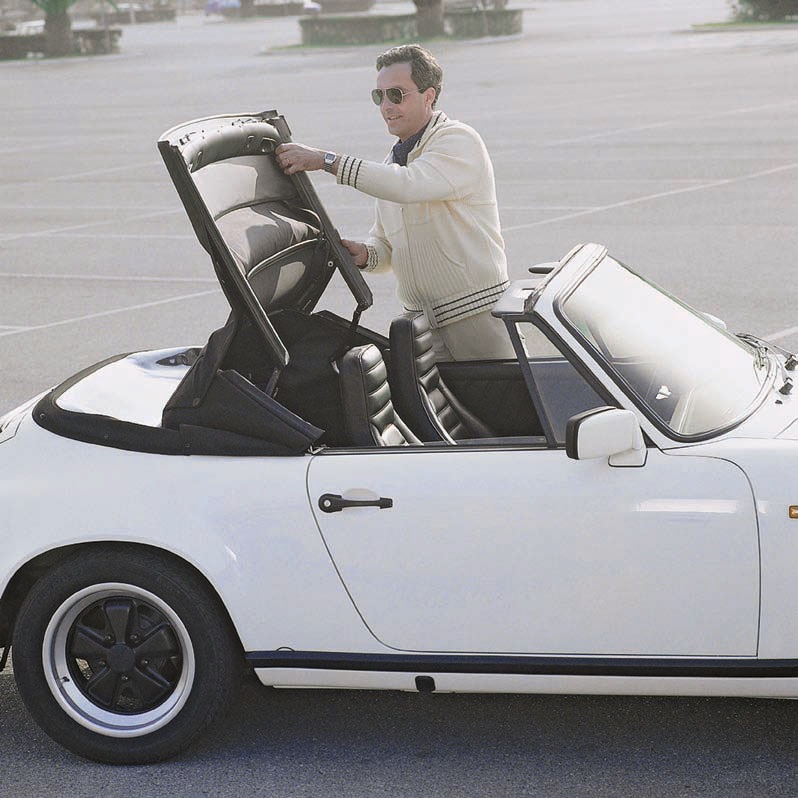
Trenkler and Schröder addressed each item on Bott’s list, and listened as others, Rolf Hannes of the testing department and design boss F. A. Porsche, added input. Hannes pointed out wind draft problems, and F. A. objected to the way the rubber-coated cloth ballooned up at high speed. For Schröder, this was a personal challenge; he had devised the panels, struts, and supports that kept that from happening with the 356 cloth tops. However, because this “targa” top panel had to collapse for storage, there was little he could do until the later rigid version appeared. On February 1, 1965, the car emerged as the subject of a joint memo to two dozen managers, engineers, and designers discussing a 912 for testing, a right-hand-drive 911 prototype, and the Cabrio, 13 360. A drawing at the bottom of the second page suggested that decisions had been made. This combination of crucial considerations killed the Cabrio and brought about its alternate, a model that marketing and sales named the Targa. Helmuth Bott and his staff had identified specific locations on the 901 unibody that required reinforcement for a cabriolet. They added bracing ahead of and behind the doors, and through the rocker panels. A rollover bar, judiciously disguised, restored a great deal of the rigidity and stiffness to the car. The question was where it was to be located, and what it was to look like. “I discussed with Mr. Schröder how we make this bow,” Kolb recalled. “It must be metal that will not rust. And we have to make the bow stiffer. I kept trying to consider the safety, to make it strong like the metal on the side of a road. He said ‘No, not yet. First we make it look right, and then we can make it strong enough.’ “One day a coupe appeared in the studio.” Kolb and Schröder gathered up some transparent materials and laid them over the top of the car. They roughed in some lines in pencil. Because they were hard to see, Kolb retrieved some black tape from the studio and remade the lines. “And then we began to move lines back and forth to define the bar. Butzi thought it was ugly. We changed the shape, some, just a little, Butzi said okay, and then I started to make the drawings. And the idea of using stainless steel came from Butzi, right at the very beginning,” Kolb said. “It was Mr. Bott,” he continued, “who insisted on the removable soft rear window. He wanted as much as possible to enhance the open car feeling. Then of course,” he went on, “the discussions came about what to call it and how to market it. Was it Porsche’s ‘open car?’ Feelings about the American market prevailed. We promoted it as our coupe with a safety item, as ‘Porsche’s Safety Car.’” As Ferry had done with the 901, he debuted the Targa nearly two years in advance of first deliveries, at the IAA show in Frankfurt in September 1965. Barely a month earlier, on August 11, Porsche had registered the patent for the Targa, No. 1455743, listing designer Gerhard Schröder and engineer Werner Trenkler as its inventors. (Registering this patent was one of Erwin Komenda’s last tasks within Porsche. He had worked with—or for—one Porsche or another for more than 35 years. Colleagues from that time suggest that he changed when Ferry Porsche pushed aside his ideas for the next Porsche. His rebelliousness toward Ferry simply may have been his assessment that no other designer could measure up to his own ideas or to those of Ferry’s father, no matter what their family name was. For several years he had suffered from lung cancer even as he continued working. He left the company in late 1965 and he died on August 23, 1966. He was 62.) “ I discussed with Mr. Schröder how we make this bow. It must be metal that will not rust. And we have to make the bow stiffer. I kept trying to consider the safety, to make it strong like the metal on the side of a road. He said ‘No, not yet. First we make it look right, and then we can make it strong enough.’ — Eugen Kolb Just in advance of the September show, Porsche issued a press release announcing the new model and its name. September proved to be another decisive month for Porsche. The Targa debut was a tremendous success with crowds as excited as they had been two years earlier seeing the New Porsche. Clever and creative marketing promoted the new car as four-in-one: With its roof and rear window removed, this was the Targa Spyder; it was the Bel-Air with its rear window zipped in place but the top open. Reversing that order, with top on but rear window collapsed, earned the vehicle the name Targa Voyage, and completing the lineup, with all panels in place, marketing called the car the Targa hardtop. Ferry, his direction set, discontinued production of the 1600cc S engine as well as the S and SC model cars. Porsche cabriolet manufacture ceased as well, except for a limited run in 1965 for the Dutch highway police. Within days of the end of the IAA, Bott took a Targa prototype to Wolfsburg’s test track for endurance testing. He learned the car needed further reinforcement at the rear doorsills and along the heater tubes. An even more demanding durability test took place in Zuffenhausen on November 10. Bott and Werner Trenkler supervised a drop test on the Targa, inverting a car, hanging it by a crane, and releasing it from two meters above the pavement. If Porsche was going to promote the car as a safety vehicle with rollover protection, Bott wanted to be certain it could handle more than a mere rollover. It didn’t. Trenkler reworked the roll bar, its mounts, and the surrounding structure, as well as the windshield frame, and in early January 1966, Bott returned to Wolfsburg with the improved prototype where drivers ran it longer and harder over the endurance test without any failure. One year later, on January 23, 1967, Porsche began production of the Targa as a 911 and 912 model.
THE ITALIAN ROADSTER EXPERIMENT With no knowledge that the Targa was coming, and with no production Cabrio on the price list, California Porsche distributor Johnny von Neumann took matters into his own hands. He had done that before, teaming up with Max Hoffmann to conceive and promote to Ferry Porsche the sales potential for a Typ 540 Speedster to follow on the heels of the America Roadster in the early 1950s. This time, he bypassed Hoffmann and Porsche altogether, taking his idea to Italy to Nuccio Bertone, who, over the next nine months, designed and fabricated a roadster body on a 911 chassis. Von Neumann funded the work himself, hoping to license the design to Porsche. He was a racer and a consummate salesman, but he was not an engineer, and the project stumbled over obstacles he had not foreseen. He was unaware of how much structural stiffness the 911 chassis lost without its steel roof. What’s more, Bertone’s design, while stylish and appealing, was more Bertone than Porsche. Finally, when von Neumann offered the car to Porsche, Ferry declined it, expressing his concern that the Porsche name had come to represent quality he was not sure could be matched everywhere. The Abarth experience had made Porsche cautious.
Ferry’s engineers hardly remained idle during these years. As the 356 series had swelled with the addition of Super variants, so the 911 followed suit, introducing the more potent 911S in 1967. This engine developed 160 horsepower at 7,200 rpm out of its 1,991cc displacement. Engine designer Hans Mezger brought new technology to the engine, surrounding the cast-iron cylinder liners with a finned jacket of aluminum to promote better heat transfer to cool the engine. The S was super in many other ways, with its five-speed manual transmission as standard equipment, as well as front and rear anti-sway bars and Koni shock absorbers at all four corners. Porsche introduced ventilated disc brakes and new five-spoke forged aluminum wheels from Fuchs. The other significant 911 variant was the four-cylinder 912 model. Introduced in April 1965, Porsche adapted the powerplant from the 356SC in the car, developing 95 horsepower at 5,800 rpm from the 1600cc pushrod engine. It was a shrewd product on Porsche’s part. Priced some 5,500 DM (roughly $1,375 at the time), less than the 911, it only slightly reduced standard equipment and trim levels. Its body, brakes, wheels, and suspension were nearly the same, and many drivers were quick to point out the four-cylinder car’s better handling with its lighter engine at the rear. While the 912s came standard with a four-speed transmission, the extra cost five-speed was a popular option because it improved performance and fuel economy. Ironically, because it was such a frequent choice, at the same time Porsche introduced the 911S with a five-speed in 1967, it made the transmission standard as well in the 912. “ It was Mr. Bott who insisted on the removable soft rear window. He wanted as much as possible to enhance the open car feeling. Then of course,” he went on, “the discussions came about what to call it and how to market it. Was it Porsche’s ‘open car?’ Feelings about the American market prevailed. We promoted it as our coupe with a safety item, as ‘Porsche’s Safety Car.’” — Eugen Kolb Throughout this time and for decades before, Porsche’s engineering staff had served under contract as Volkswagen’s research and development division. One of Ferry’s key motivations for acquiring the land and building the facilities at Weissach was to better serve VW as well as other clients who came in search of Porsche’s expertise. Being a shrewd businessman, Ferry organized Weissach so that VW’s annual contract met its operating overhead. Any other revenue was profit. With this kind of freedom, Weissach became a think tank and brainstorming center as well.
Ferry’s competition division had been campaigning mid-engine racers for more than a decade. He watched as racing competitors and road car manufacturers embraced the configuration, and, with plans to discontinue the 912 a few years ahead, he needed an attractive, interesting entry-level model. With memories of the costs of designing, developing, testing, and launching a new model still fresh in his mind, he wanted a collaborator. VW chairman Heinrich “Heinz” Nordhoff had been a strong supporter since late 1948, when he signed VW’s postwar agreement with Porsche for design and engineering work. By 1966, the Beetle was long in the tooth and his Karmann Ghia coupes and convertibles had gone into redesigned second-generation models that garnered less enthusiasm. The 411, an updated, redesigned three-box-style rear-engined air-cooled sedan progressed toward launch as a 1969 model. But something sporty might enhance VW’s image, replacing the Karmann Ghia and possibly bringing new customers into Porsche. Together, the two companies devised the mid-engine Typ 914, using a 1.7-liter flat four for the Volkswagen version and the 110 horsepower two-liter flat six from the new T (for Touring) model. While many designers have been given credit for its appearance, it was Heinrich Klie who created the radically non-Porsche forms, shapes, styles, and lines of the identical twin VW and Porsche products, these being a dramatically lower and seemingly elongated rendition of the three-box 411, while working in F. A. Porsche’s basement design studio. Harald Wagner and his marketing and sales staff welcomed the proliferation of models, and for 1968, he and his team were happier still. Porsche continued the 912 four-cylinder models in coupe and Targa variations, as well as the 911S. It added the entry-level 911T, whose flat six developed 110 horsepower at 5,800 rpm. For European markets, the base 911 became the 911L, for Luxus, or luxury. However, for the United States, Porsche had not yet met emissions standards with its S model, and the L was as good as it got, supplemented by T and 912 versions.
Visually the cars evolved in understated ways. On the instrument panel, new gauges put white letters and numbers on black surfaces surrounded by black trim rings. Windshield wipers went matte black and Porsche engineers reconfigured their operation so the sweeping motion rose up from in front of the driver, arcing to the right on start-up. Ferry had kept his engineers busy for the past several years on a semiautomatic gearbox project he imagined had great appeal to his U.S. customers. He introduced the Sport-o-Matic transmission and was surprised to find that more European customers than Americans chose the optional fourspeed torque-converter system. There was no clutch pedal for the driver and an engine vacuumoperated servo actuated the clutch at the transmission housing. Model year 1969 brought significant changes to 911 engines (and signaled the end of the 912 series). A mid-level 911 arrived to replace the 911L. The new 911E (for einspritzung, or injection), and the 911S engines now used a Bosch/Porsche mechanical fuel injection system. Fuel injection had appeared on Porsche’s 906 race cars in 1967 to mitigate the fuel feed problems that drivers experienced in extremely hard cornering. But translating racing’s needs for full-throttle/hard braking to the wider varieties of driving conditions on public roads was not easy. Engineer Rolf Sprenger, who later went on to establish and operate Porsche’s Sonderwunsch, or Special Wishes, customer service department, started his career as a research engineer in fuel systems with Bosch. One of his earliest assignments at Porsche was adapting fuel injection to series cars. “For a racing car,” Sprenger explained, “where you mainly drive at high revs, you don’t ask for fuel consumption, not in those times. But on the production car, you have to be very lean, you have to have a good consumption, and you have to have a good output. So, we made a very sensible fuel pump, a very accurate pump.
“The racing pump was a six-cylinder pump in those days, but it was in-line. Our first tests we did with the pump like this, but then we turned to what we called the double row pump, which had three plungers on each side and a smaller housing. “We did really a great deal of research on fuel injection on air-cooled engines. Mercedes and others already had fuel injection systems in production cars, like the 220 and 300. They had mainly two-plunger pumps and they converted those to six or eight cylinders. We had plungers for each cylinder. But we had no water-cooled engines, which keeps heat better. Especially when you move over a hill and pull back the throttle. On zero load, as we call it, with the air-cooled engine, it didn’t keep warmth so much. So the engine was a little bit colder down in the valley, and when you accelerated, you found you had insufficient fuel. “And also the barometric pressure! For heights, the elevation. If you are in a higher region, you had not enough air so you needed less fuel in order to have the right mixture. And this was another difficult thing to work out. We had to find a system that, in high altitudes, the output was less than at lower levels. “In those days we didn’t have the electronic pump. There was some development, but the electronic pump that Volkswagen was developing came a couple of years later. In those days, my colleagues in Bosch did some research, but that was never accepted for production. So we had to live with the mechanical one.” Porsche’s first series prototypes ran with fuel injection in late summer to autumn 1967. There were discoveries, surprises, and more work. “Well, they worked, but. . . . there was a lot of backfiring. When we pulled back the [linkage] lever on zero load, we found out that it backfired. We learned to stop fuel delivery completely,” Sprenger said. “We thought we should deliver a small amount, but that was wrong. So we had to cut fuel delivery completely.
“And then it was very difficult to find just the right place to place the injector nozzle to get the maximum output. With fuel injecting the old Mercedes racing engine, it was the so-called direct injection. They pushed the mixture into the combustion chamber. We tried this, but we thought this might be too expensive because you have special nozzles because of the heat! So we said, okay, we spray in the inlet manifold. But then we had the problem to find out where is the right place. What is the right nozzle? What is the right angle for the nozzle? It was a lot of research!” Dialing in all the variables not only eliminated cornering fuel cutout and improved fuel efficiency, but it also added 10 horsepower to the injected engines for model year 1969. The 911E arrived with 140 horsepower at 6,500 rpm, and the S owners got 170 at 6,800 rpm. Along with the mechanical injection came capacitive-discharge ignition systems, both devices that cleaned up emissions as well. The L designation disappeared for 1969 from European and U.S. models, and American buyers once again found S versions available. Another significant change occurred on the 1969 models. To improve handling, Porsche engineering lengthened the wheelbase 57 millimeters, about 2.24 inches, from 2,211 millimeters to 2,268. E and S models rode on new wider wheels that had grown from 4.5Jx15 on the 901 and early 911s, to 5.5J for 1968, to 6Jx15 for 1969. This required a slight flare on front and rear quarter panels to accommodate the wider wheels and tires.