Associated albums


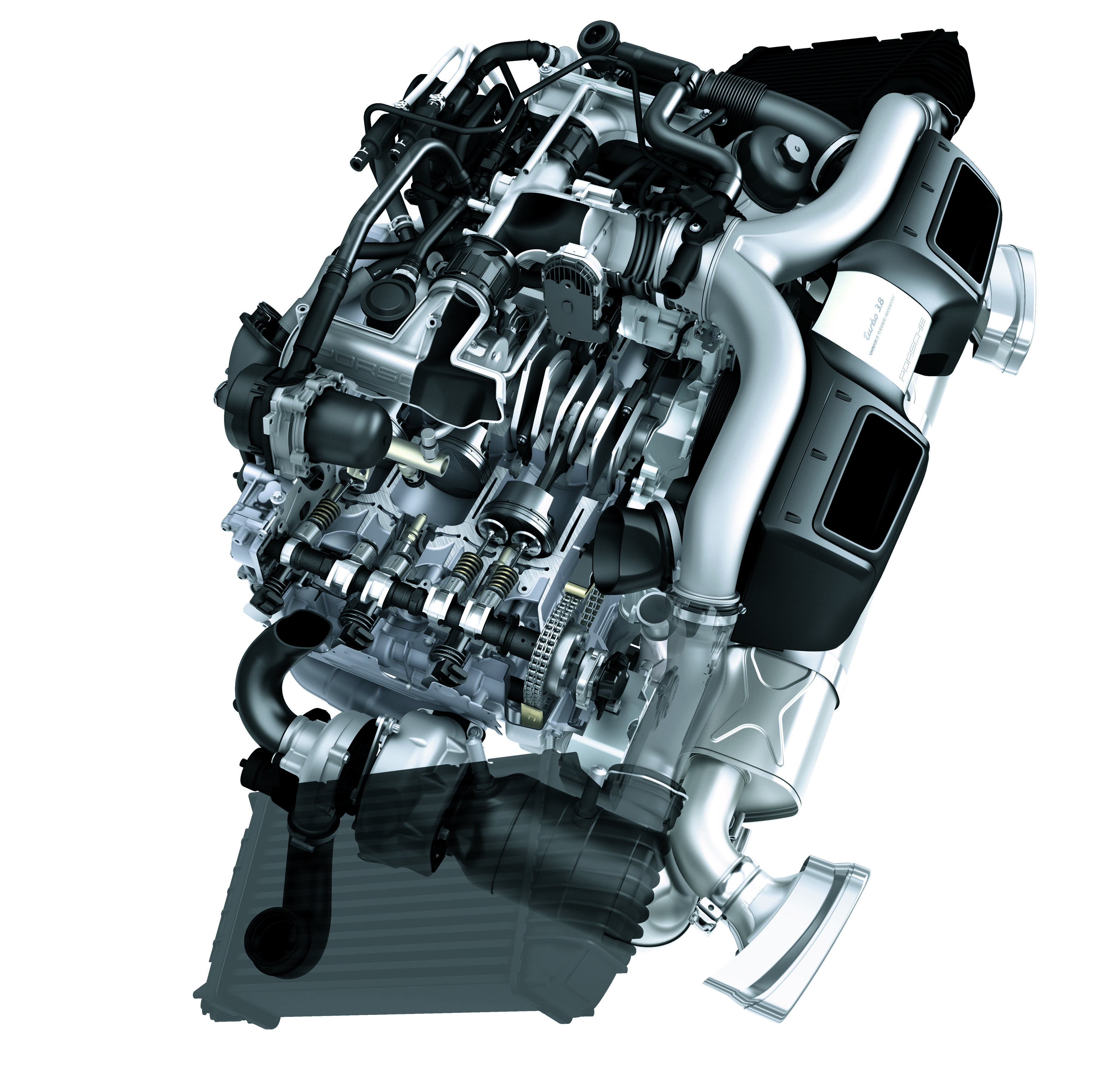
BABY Hans Mezger and Norbert Singer conceived their “baby” as a result of challenges within the company and without. Porsche’s dominance in the World Championship of Makes with its turbocharged 935 motivated BMW to regroup as a two-liter competitor in the German National Championship (GNC), running against well-prepared Ford Escorts. Spectators and journalists suspected that each marque had its own series. As racer/journalist Paul Frère explained in his Porsche 911 Story, “The press was not always very kind to Porsche for not joining the Ford-BMW battle, sometimes even implying that they were afraid to do so.” Porsche simply had no car for that class. Then in early April, Fuhrmann discovered that German television planned to broadcast the two-liter race, but it was going to ignore the larger-displacement class event scheduled at the Norisring in early July. For the next two months, Mezger and Singer created a car. To meet the two-liter limit, Mezger created a 1.4-liter version of an existing engine. Singer found ways to pull some 540 pounds out of their 935/77 race cars to bring one down to the 1,598-pound minimum for the two-liter class. The two-liter engine case was too large and heavy even for the 71x60-millimeter bore and stroke, but it did allow Mezger to select a much smaller air-to-air intercooler that fit inside a standard rear deck lid. With overall displacement of 1,425cc and turbo boost at 20 psi, the engine developed 370 horsepower at 8,000 rpm. Eugen Kolb, Singer’s body engineer, delivered a car that, as the full-size 935 had been, came in underweight at 1,565 pounds, allowing them again to ballast it in places that were most useful. The development schedule left no time for testing, and as Frère wrote, “The engine had been bench tested only and [it] turned out to lack flexibility to the point of being almost undriveable, which was made worse by gear ratios that were much too high.” Norisring did not go well. Two weeks later at Hockenheim, Singer and Mezger had sorted out everything. Jacky Ickx lapped the 4.24-mile circuit two seconds quicker than anyone else, and he finished the race half a nearly three miles ahead of second place. With his point made, Fuhrman had the Typ 935/2, or “baby” as Singer’s staff had christened it, retired to the museum collection.

Porsche’s next efforts to update its 935 came with the 935/78, most widely known as Moby Dick. While Singer and his Weissach cohorts continually improved the 935 and shared these innovations with customers, excellence, as one publisher expressed it, was expected. In this vehicle, Singer, Mezger, and Kolb applied everything they had learned to create Porsche’s most radically innovative race car yet. To address engine failures that had plagued the factory and private racers, Mezger water cooled new four-valve cylinder heads while leaving the rest of the engine air-cooled as Group 5 rules required. With new bore and stroke of 95.8x74.4 millimeters, this engine displaced 3,211cc for calculated displacement of 4,495cc. Running 20psi boost through the twin turbos developed 750 horsepower at 8,200 rpm. The 4.5-liter displacement figure provided Singer a 2,260-pound minimum weight for a car that utilized every aerodynamic trick he had developed. His engineers fabricated an aluminum alloy tube frame welded to the full roll cage. Regulations allowed him to raise the floor to the height of the doorsills. Instead, Singer mounted a fiberglass floor pan on the tube frame and dropped a heavily modified body onto it so the sills met the lowered floor. Because fenders were free of regulation, Singer and Kolb widened them to the limits, working for hours in wind tunnels to devise and perfect the slipperiest shapes. Within the long, low body, Mezger’s and Singer’s engineers concluded that it was possible only to mount the transmission upside down to manage suspension arm and halfshaft angles. They took the car to Circuit Paul Ricard in France for testing. With all its aerodynamic bodywork in place, but not yet painted in Martini colors, it was a large white car. That day it earned the nickname Moby Dick.

With this car developed specifically for Le Mans, Porsche hesitated to run it or its twin elsewhere as it competed directly against their customers. In its first outing at the 6 Hours at Silverstone, a month before the French 24-hour trial, Mass and Ickx in chassis 006 simply walked away from the rest of the 30-car field. They finished seven laps ahead of Bob Wollek and Henri Pescarolo in a Kremer-entered customer 935/77A. In June at Le Mans, chassis 007 routinely hit 220 miles per hour along the Mulsanne Straight. It ran with and frequently led the Group 5 pack until around 10 a.m. Sunday, 18 hours into the race. Then a minor oil leak slowed the pace that co-drivers Jacky Ickx and Jochen Mass were driving as Mezger’s engineers feared a crack in the crankcase. At the end of the race, the car finished eighth overall, and back at Weissach, engineers determined the leak was minor and inconsequential. Chassis 006 ran at the 6 hours at Vallelunga in September but retired with ailing fuel injection. The wild experiment ended with the season, which went to Porsche through the great work of its customers in their 935/77As. In the United States, SCCA organizers rewrote rules to parallel the FIA Group 4 and 5 as Category II, welcoming tube-frame silhouettes. Greg Pickett, driving a Corvette, took the season honors. The IMSA season was a different story with 935s racing in the new GTX category. Peter Gregg, collaborating with a variety of co-drivers for Brumos, won at Daytona (twice), Talladega, Road Atlanta (twice), Lime Rock, Brainerd, and Portland during the season to claim the title. For 1979, Porsche withdrew from competition itself, but it delivered a run of 935/79 single turbo models with the inverted transmission, primarily to IMSA competitors. Because the 935 remained the best game in town, the Cologne-based Kremer brothers, Erwin and Manfred, took up the slack and began delivering their own highly developed aluminum tube-frame 935s, designated the K3 using sleek Kevlar bodies designed by Ekkehard Zimmermann. The Kremers built full cars for several customers and sold K3 kits to others to update earlier factory 935s.

The racing season once again began with Daytona, where FIA and IMSA shared some rounds on the calendar. Racer/car owner Ted Field had worked his way up from 911s to Carrera RSRs to 934s to a 935K3 over a period of years, establishing a solid reputation. For several years he teamed with former drag racer Danny Ongais, and they ran black-painted well-prepared cars. Everything came together for them at Daytona, where, with past-winner Hurley Haywood, they started eighth and finished first by never putting a footstep or a tire patch wrong. In the 22nd hour, they slacked their pace because they had built up a 50-lap lead over second place. Ironically, ten minutes before the checkered flag, their turbocharger blew up. Ongais limped the car around, trailing smoke, and he coasted over the finish line to victory. Six weeks later at Sebring, Field and Ongais failed to finish and the honors went to Dick Barbour’s 935/77A. The WMC spent the rest of the season commuting between Europe and the States, where either Georg Loos, the Kremer brothers, or the American Whittington Brothers, Don and Bill, claimed the wins. In the IMSA series Peter Gregg and Brumos had their way with the GTX class again, winning eight of fifteen starts and claiming the title again. For the SCCA Trans-Am title, John Paul Sr. took honors, making it a clean sweep for the 935s in all the major series. The SCCA enforced a new set of rules for 1980, initiating an engine displacement-to-weight ratio that steered the competition away from the 935s. IMSA’s 15 rounds started and ended with Daytona again, visited Road Atlanta twice, again, and stopped at some of the same venues from 1979: Sebring; Riverside in southern California; Laguna Seca at Monterey, California; Lime Rock; Brainerd; Golden State (near Sonoma, California); Portland; Mosport outside Toronto, Ontario; and Road America in central Wisconsin. Dick Barbour, running a 935K3, won at Sebring, Riverside, Laguna, Daytona (the Paul Revere 250-miler,) Golden State, and Mosport. John Paul (father and son) won at Lime Rock driving for Preston Henn and then in their own car at Road America. Gianpiero Moretti took the final two victories, at Road Atlanta and the Daytona GT 250 finale. In North America, any hope at winning made a 935 inevitable.

In Europe, Italian carmaker Lancia, which had made tentative steps in 1979, fielded a two-car team for the 1980 full season. Lancia added variety to what racing audiences saw on the circuits. Longtime Porsche loyalist Reinhold Jöst introduced his own 935 variation for 1980 and wasted no time establishing its credentials. With co-driver Rolf Stommelen, Jöst’s new 935J won Daytona with a decisive margin of 33 laps over Al Holbert and John Paul Sr. in Preston Henn’s 935K3. Ted Field and Danny Ongais, in the Interscope K3, came in third. In a quirk of scheduling, the WMC series jetted off to Brands Hatch for a six-hour round after Daytona and before Sebring, where new Lancia Beta Monte Carlos announced to race goers that they had arrived. They finished first, second, and fourth, ahead of the best-placed 935K3 from Charles Ivey. At Sebring the results sheets looked more familiar with Dick Barbour winning over Ted Field, the Whittingtons coming in third, and Preston Henn taking fourth, in 935K3s all. Mugello, not surprisingly, bounced the ball back in Lancia’s court, with their Beta Monte Carlos again claiming first, second, and fourth, although this was a round the K3 racers chose to pass. Monza proved a better mix with Alain de Cadenet taking the six-hour checkered flag in his own Ford-Cosworth-powered Lola-chassis “de Cadenet.” Jürgen Barth and Henri Pescarolo chased him on the same lap to finish second, ahead of third-place Lancia, one lap down. Racing in Europe offered variety, where in North America it remained a K3 show. The WMC title for cars greater than two-liter displacement again went to Porsche while Lancia claimed the distinction in the smaller displacement group. John Paul Sr. took the top driving title.

Through 1980 and 1981, most of Porsche’s racing engineers spent their time and effort designing and testing a new mid-engine water-cooled race car, the Typ 956, meant for FIA Group C and for the GTP or prototype classes. But they still found time to develop improvements and upgrades to the five-year-old 935s. As Janos Wimpffen reported, “The engineers did produce a much more robust engine package. Its principal features were bigger everything.” Larger oil pumps, turbos, and intercoolers, and improvements in aerodynamics, body, chassis, and suspension advanced the benchmark that 935 performance and reliability represented. The Kremers, and Jöst, as well as John Paul Sr., Gianpiero Moretti, and John Fitzpatrick who acquired Dick Barbour’s K3 after Barbour retired, each made significant modifications to their cars to present the GTPs a challenge for 1982. The 935s performed consistently through 1981, winning seven of the fifteen WMC rounds and giving Porsche and Porsche driver Bob Garretson their championship titles. Owners who raced 935s did not park them with the arrival of FIA World Endurance Championship (WEC) Group C and IMSA GTP regulations. IMSA found the premise of FIA’s Group C consumption regulations stifling to competition and, except for Daytona and Sebring, they contested no other races in common. What’s more, nearly all entries in both these Florida races came from North American teams. Initially there were few of the prototypes anyway, so the FIA Group 5 entry lists remained robust while IMSA GTX cars became GTPs. So it’s little surprise that both Florida races went to GTP 935s that John Paul Sr. and his son built and raced. In some of the European WEC events, no 935s started, though at Le Mans, John Fitzpatrick in a Jöst 935-78/81 finished fourth overall and first in GTX. Charles Ivey’s 935K3 took Group 5 honors. Out of a field of 55 starters, only six were 935s. By the end of the season, 935 entries could be counted on the fingers of one hand. This suited Weissach well. Peter Schutz’s arrival at Porsche had allowed Helmuth Bott to follow some instincts that he had hidden while Ernst Fuhrmann still ran things. Bott was fascinated by the work Ferdinand Piëch’s engineers at Audi were doing with four-wheel drive, especially for international rallying in FIA Group B. FISA, Fédération Internationale du Sport Automobile, the sanctioning organization for rallies, legalized all-wheel drive in 1979, but few manufacturers embraced it, wary of its costs and the weight it added to their race cars. Regulations for Gruppe B, modified sports cars that encompassed the former Group 4 sports cars, took effect in 1982. They encouraged experimental technology, but FISA needed 200 examples to prove it was modified from something already existing. For rallies, Porsche felt it had some advantage with its rear engine/rear drive. But within Weissach, a group of Bott’s engineers advocated a different configuration.

“My racing engineers wanted to do a mid-engine car,” Bott recalled in an interview in 1992 after he retired from Porsche. “They wanted to take a car on the base of the 914 and make a race car, as a Gruppe B car. And I was fighting against them. I said, ‘We do so many mid-engine cars. We cannot learn anything.’ And the second thing that we don’t know is if any other company is making a Gruppe B car. If not, what can we do with our Gruppe B car? We build a very expensive car, we spend a lot of money, and what do we have, nothing. You had to build 200 cars. That’s a lot, much too much for Porsche from the money side.” Bott argued that the requirement for 200 cars could serve as a development run for 1,000 or 5,000 series production models. With Schutz’s commitment to reinvigorate the 911, Bott saw an opportunity to look into its future. “Let’s take all the electronics systems and all the knowledge from today,” he said, “and let’s take a very powerful engine to see the limits of the chassis and the road holding and the fourwheel drive and all these things. So, it was a goal, a task much greater than to build a race car. You see our concept with the 911 has always been that it’s an all-around car. With very few changes, you can drive a rally, and then go to the racetrack at Le Mans, and to win the long distance.” But, starting as late as 1981, he never could get 200 examples funded, let alone built in time to compete. “Well,” he recalled, “there was no other race we could do because the homologation was not done. We had to race that car where prototypes are free to take anything.
Previous Page Page 26 Next Page