Ferry’s competition division had been campaigning mid-engine racers for more than a decade. He watched as racing competitors and road car manufacturers embraced the configuration, and, with plans to discontinue the 912 a few years ahead, he needed an attractive, interesting entry-level model. With memories of the costs of designing, developing, testing, and launching a new model still fresh in his mind, he wanted a collaborator.
VW chairman Heinrich “Heinz” Nordhoff had been a strong supporter since late 1948, when he signed VW’s postwar agreement with Porsche for design and engineering work. By 1966, the Beetle was long in the tooth and his Karmann Ghia coupes and convertibles had gone into redesigned second-generation models that garnered less enthusiasm. The 411, an updated, redesigned three-box-style rear-engined air-cooled sedan progressed toward launch as a 1969 model. But something sporty might enhance VW’s image, replacing the Karmann Ghia and possibly bringing new customers into Porsche. Together, the two companies devised the mid-engine Typ 914, using a 1.7-liter flat four for the Volkswagen version and the 110 horsepower two-liter flat six from the new T (for Touring) model. While many designers have been given credit for its appearance, it was Heinrich Klie who created the radically non-Porsche forms, shapes, styles, and lines of the identical twin VW and Porsche products, these being a dramatically lower and seemingly elongated rendition of the three-box 411, while working in F. A. Porsche’s basement design studio.
Harald Wagner and his marketing and sales staff welcomed the proliferation of models, and for 1968, he and his team were happier still. Porsche continued the 912 four-cylinder models in coupe and Targa variations, as well as the 911S. It added the entry-level 911T, whose flat six developed 110 horsepower at 5,800 rpm. For European markets, the base 911 became the 911L, for Luxus, or luxury. However, for the United States, Porsche had not yet met emissions standards with its S model, and the L was as good as it got, supplemented by T and 912 versions.
Visually the cars evolved in understated ways. On the instrument panel, new gauges put white letters and numbers on black surfaces surrounded by black trim rings. Windshield wipers went matte black and Porsche engineers reconfigured their operation so the sweeping motion rose up from in front of the driver, arcing to the right on start-up.
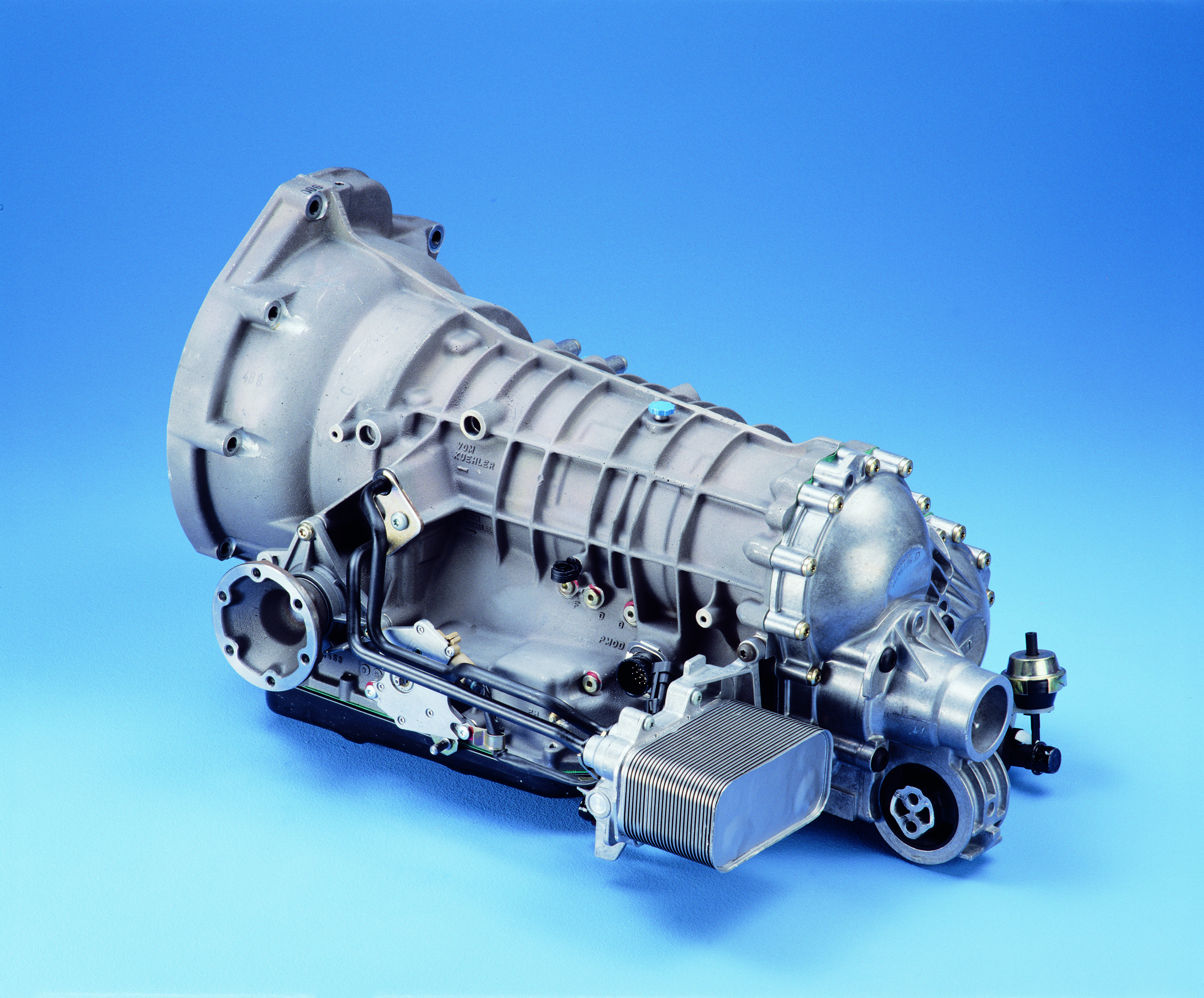
Ferry had kept his engineers busy for the past several years on a semiautomatic gearbox project he imagined had great appeal to his U.S. customers. He introduced the Sport-o-Matic transmission and was surprised to find that more European customers than Americans chose the optional fourspeed torque-converter system. There was no clutch pedal for the driver and an engine vacuumoperated servo actuated the clutch at the transmission housing.
Model year 1969 brought significant changes to 911 engines (and signaled the end of the 912 series). A mid-level 911 arrived to replace the 911L. The new 911E (for einspritzung, or injection), and the 911S engines now used a Bosch/Porsche mechanical fuel injection system. Fuel injection had appeared on Porsche’s 906 race cars in 1967 to mitigate the fuel feed problems that drivers experienced in extremely hard cornering. But translating racing’s needs for full-throttle/hard braking to the wider varieties of driving conditions on public roads was not easy.
Engineer Rolf Sprenger, who later went on to establish and operate Porsche’s Sonderwunsch, or Special Wishes, customer service department, started his career as a research engineer in fuel systems with Bosch. One of his earliest assignments at Porsche was adapting fuel injection to series cars.
“For a racing car,” Sprenger explained, “where you mainly drive at high revs, you don’t ask for fuel consumption, not in those times. But on the production car, you have to be very lean, you have to have a good consumption, and you have to have a good output. So, we made a very sensible fuel pump, a very accurate pump.
“The racing pump was a six-cylinder pump in those days, but it was in-line. Our first tests we did with the pump like this, but then we turned to what we called the double row pump, which had three plungers on each side and a smaller housing.
“We did really a great deal of research on fuel injection on air-cooled engines. Mercedes and others already had fuel injection systems in production cars, like the 220 and 300. They had mainly two-plunger pumps and they converted those to six or eight cylinders. We had plungers for each cylinder. But we had no water-cooled engines, which keeps heat better. Especially when you move over a hill and pull back the throttle. On zero load, as we call it, with the air-cooled engine, it didn’t keep warmth so much. So the engine was a little bit colder down in the valley, and when you accelerated, you found you had insufficient fuel.
“And also the barometric pressure! For heights, the elevation. If you are in a higher region, you had not enough air so you needed less fuel in order to have the right mixture. And this was another difficult thing to work out. We had to find a system that, in high altitudes, the output was less than at lower levels.
“In those days we didn’t have the electronic pump. There was some development, but the electronic pump that Volkswagen was developing came a couple of years later. In those days, my colleagues in Bosch did some research, but that was never accepted for production. So we had to live with the mechanical one.” Porsche’s first series prototypes ran with fuel injection in late summer to autumn 1967. There were discoveries, surprises, and more work.
“Well, they worked, but. . . . there was a lot of backfiring. When we pulled back the [linkage] lever on zero load, we found out that it backfired. We learned to stop fuel delivery completely,” Sprenger said. “We thought we should deliver a small amount, but that was wrong. So we had to cut fuel delivery completely.
“And then it was very difficult to find just the right place to place the injector nozzle to get the maximum output. With fuel injecting the old Mercedes racing engine, it was the so-called direct injection. They pushed the mixture into the combustion chamber. We tried this, but we thought this might be too expensive because you have special nozzles because of the heat! So we said, okay, we spray in the inlet manifold. But then we had the problem to find out where is the right place. What is the right nozzle? What is the right angle for the nozzle? It was a lot of research!”
Dialing in all the variables not only eliminated cornering fuel cutout and improved fuel efficiency, but it also added 10 horsepower to the injected engines for model year 1969. The 911E arrived with 140 horsepower at 6,500 rpm, and the S owners got 170 at 6,800 rpm. Along with the mechanical injection came capacitive-discharge ignition systems, both devices that cleaned up emissions as well. The L designation disappeared for 1969 from European and U.S. models, and American buyers once again found S versions available.
Another significant change occurred on the 1969 models. To improve handling, Porsche engineering lengthened the wheelbase 57 millimeters, about 2.24 inches, from 2,211 millimeters to 2,268. E and S models rode on new wider wheels that had grown from 4.5Jx15 on the 901 and early 911s, to 5.5J for 1968, to 6Jx15 for 1969. This required a slight flare on front and rear quarter panels to accommodate the wider wheels and tires.
Perhaps this was an early form of just-in-time delivery as painted 930 Turbo bodies waited outside the factory. These cars were queued up for engine-and chassis marriage and for interior completion. Porsche Archiv
Another Stemmann sketch identified the concept as the 911 Turbo. The wide-body approach served well for auto show introductions. Porsche Archiv
The 1981 Frankfurt IAA Cabrio studie used Porsche’s 3.3-liter turbo engine. At Frankfurt, Porsche displayed the car on mirrors to show off its high-tech all-wheel drivetrain. Porsche Archiv
Following the Frankfurt IAA introduction, Porsche had 911 SC Cabriolets available for delivery as 1983 models in late 1982. Weissach invested huge effort into stiffening the chassis for the open car. Porsche Archiv
Celebrities, especially musicians, have owned Porsches and, because of their celebrity, have gotten special options. Violinist Anne-Sophie Mutter ordered this 1983 SC Cabriolet with red leather interior and a red leather convertible boot. Dieter Landenberger/Porsche Archiv
To fit a collapsible top into the 911 body, engineers Eugen Kolb and Gerhard Schröder moved the rear seatbacks forward nearly four inches. A complex structure of bows and straps restrained the top from tenting up while driving at high speeds. Porsche Archiv
The first step was to release latches from each side of the windshield and then to unzip the rear window. From that point, lowering the top was an easy operation that anyone could do single-handedly. Porsche Archiv
The top remained a manual operation until 1987. The wide front bow, to which factory assemblers glued the cloth top, was one secret to its stability at high speed. Porsche Archiv
Despite introduction of the 1983 Cabrio, the Turbo remained a steady seller through its entire life as a G model. Specifications barely changed as engineers, with other assignments from Bott and Schutz, worked on the all-wheel-drive Turbo known as the 959. Porsche Archiv
As chief executive of Techniques Avant-Guard (TAG), Mansour Ojjeh, right, collaborated with Porsche on engine development and other technologies for the McLaren F1 team partnership. Here with Manfred Jantke (Porsche press director), Ojjeh inspected a 935 that Sonderwunsch developed for road use for him. Porsche Archiv
Raw turbo bodies moved along the assembly line in 1984. Between model year 1978 and the end of the G Series in 1988, Zuffenhausen assembled nearly 15,000 Turbos. Porsche Archiv
Porsche made use of Volkswagen’s “tank” proving ground while developing its Typ 953 all-wheel-drive prototypes. Engineer Roland Kussmaul and a team of specialists spent weeks at the Ehra-Lessien test facilities through 1983. Porsche Archiv
The Frankfurt IAA show Gruppe B prototype looked startling in any light. Its performance capabilities matched, if not exceeded, its futuristic appearance. Porsche Archiv
Engineers diagrammed the lighting devices for the 959, completing the drawing on September 26, 1984. With its dual-language legend, it clearly was intended for export purposes. Porsche Archiv