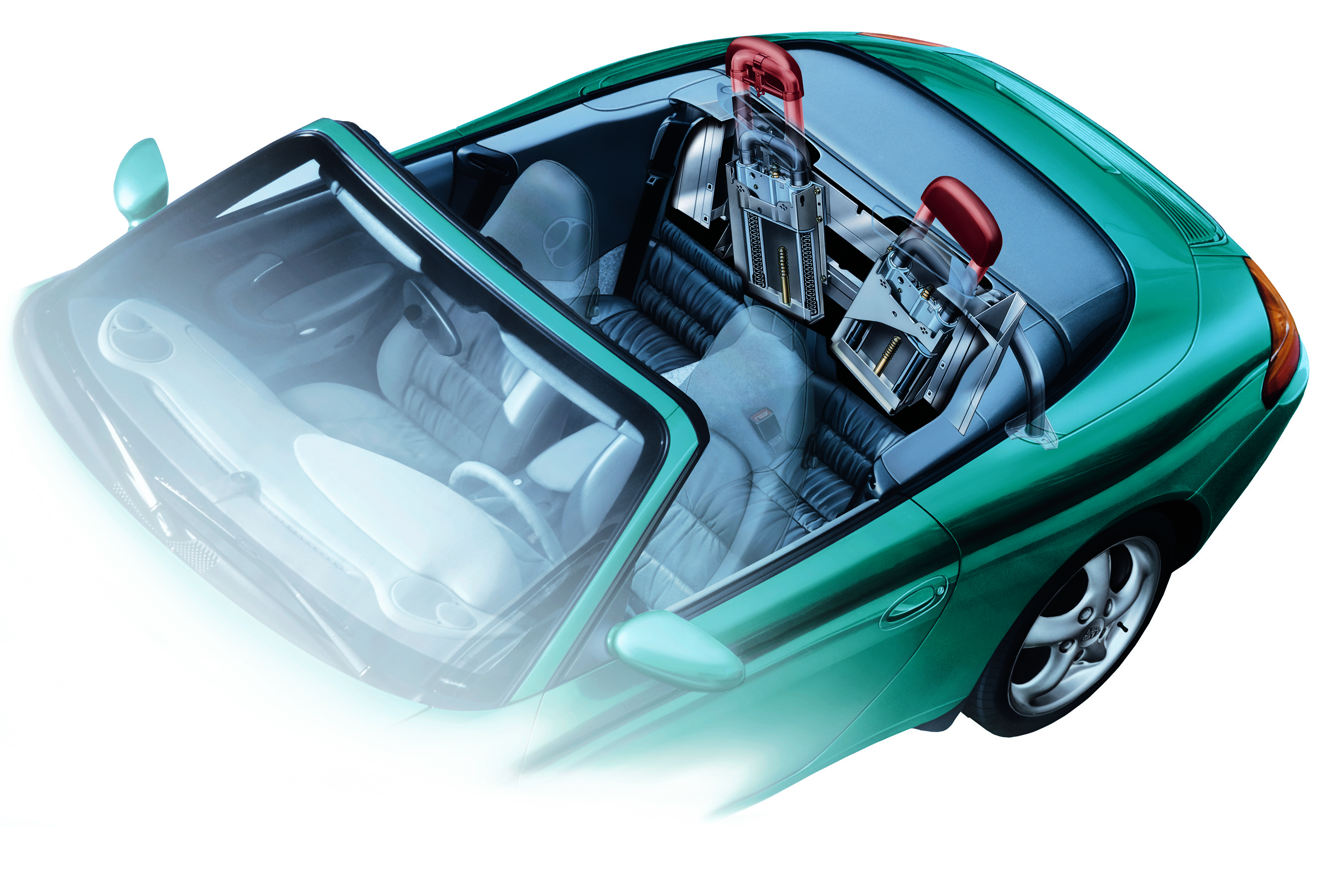
As if Ferry’s engineers had not been busy enough, one further development reached the 911 marketplace at this time. In an effort to further improve ride and handling, Porsche introduced a hydro-pneumatic strut front suspension system. While it was standard on the E, it was available as an option on the T and S models. The system automatically compensated for changes in front loads from fuel use and luggage placement.
The four-passenger 911 concept briefly returned from the dead in 1969 and then again in 1970 with two proposals that proved that certain proportions are, if not inviolate, at least not elastic. F. A. Porsche contracted with Pininfarina in Italy who developed the B17 prototype, a car that the Porsche Museum displays on its main floor. Pininfarina added 192 millimeters, 7.6 inches, to the wheelbase behind the B-pillar, allocating the extra space to slightly longer seats and foot room for adults. But all this additional steel and glass pushed the car’s weight up to 2,497 pounds. In Pininfarina’s hands, Fritz Plaschka’s big line roof slope rose and swelled awkwardly.
A year later, F. A.’s staff took a try at it with the 911C/20. Pushing the wheelbase out 347 millimeters, 13.7 inches, turned the coupe into a two-door stretched limousine with an overall length of 4,510 millimeters, or 177.6 inches, 14 inches longer than the 911. Visually the car was more successful than Pininfarina’s; both Plaschka’s and Schröder’s input and F. A.’s sense of proportion were evident. However, with no changes to the front suspension or steering geometry, its maneuverability suffered.
For the regular series models for 1970, production engine chief Paul Hensler enlarged displacement on the 911 engines, increasing bore from 80 to 84 millimeters to bring the engines to 2,195cc. To control weight, Porsche cast the engine cases in magnesium and used forged steel crankshafts, forged aluminum pistons, and Biral cylinders. Horsepower rose to 180 for the S model, 155 for the E, and 125 for the T. At the same time, overall weights of the cars dropped by 132 pounds. As Tobias Aichele reported, “At Porsche, lightweight design was an obsession of the new chief of development, Ferdinand Piëch.” Porsche discontinued the 912 model and introduced the mid-engine 914.
The 1971 model year saw only minor technical modifications to the cars, occurring in ignition and fuel injection systems to meet evolving emissions restrictions. Bigger changes happened for economic reasons, as Porsche and Germany monitored the value of the DM compared to the dollar, going from 3.92 DM in 1969, to 3.65 in 1970, to 3.48 in 1971. Porsche prices rose in the United States because dollars bought fewer Deutschmarks. A recession in America made things worse. As the staff watched the 150,000th Porsche leave the factory, a 911S going to its new American owner (himself a seven-time Porsche buyer), Ferry cut production and then shortened the workweek. Annual production fell to 11,715 cars, the lowest level in five years.
“ For a racing car where you mainly drive at high revs, you don’t ask for fuel consumption, not in those times. But on the production car, you have to be very lean, you have to have a good consumption, and you have to have a good output. So, we made a very sensible fuel pump, a very accurate pump.”
— Rolf Sprenger
That was the public news. Inside Werk I, another problem loomed. As Ferry’s children and those of his sister Louise Piëch finished their educations, they expected a job in the family business. Among those already inside the company, issues arose that challenged the direction the products were going. One such eruption occurred between development chief Ferdinand Piëch, Louise’s son, and Ferry’s son Hans-Peter, who had headed production since 1965. Piëch believed 911 production engines needed dual-overhead camshaft configurations while Hans-Peter felt the single-cam system was fine, despite board approval authorizing the change.
This was one of dozens of disagreements that steadily altered the relationships between family members and the company. Ferry was 61 and not yet ready to step away from all that he had built. To better manage the rivalries, he called a family meeting in the fall of 1970 at the family farm in Zell am See, Austria. An outside consulting firm orchestrated the agenda. The result was startling: all the family members vacated their jobs inside Porsche Zuffenhausen and at the Piëch family holding, Porsche Salzburg, for the good of the companies, opening their jobs to trained, professional outsiders. Officially, the new rule stated that Porsche shareholders should not work in company management. Only Ferry remained at his post as chairman of the advisory board. Within a year, all of them were out or nearly so. F. A. Porsche left almost immediately to establish an independent industrial design firm, Porsche Design. Ferdinand Piëch transferred laterally at Weissach and directed Porsche’s engineering work for outside clients. Now the company needed managers.
THE FUHRMANN ERA
Ernst Fuhrmann returned to Porsche in September 1971. The 911 production for 1972 model year already was underway. New engines powered the cars with 2,341cc displacement that came about by lengthening stroke from 66 millimeters to 70.4 through a new crankshaft. Hensler’s engineers essentially were forced into this change in order to meet anticipated emissions regulations, the introduction of lead-free fuels, and the need for cars for the American market to run on regular octane gasoline. Even with these modifications, horsepower output rose, taking the T up to 130, the E to 165, and the S to 190. The new engine configuration also increased torque, an important benefit for drivers who spent more time in cities than on open autobahns.
Ferdinand Piëch had wanted for some time to reposition the oil sump reservoir from its location behind the passenger-side rear wheel to a spot ahead of it to better balance the car and neutralize handling. For 1972 he succeeded, and an exterior oil-filler cover just behind the passenger door made this difference apparent. But concerns over side-impact safety made this a single-year feature, and post-1972 production returned the reservoir to its original position.
Ernst Fuhrmann found he had plenty to do. One of the new cars for which he previewed designs was a joint project with VW to replace the aging Beetle. This car used a variation of the lowprofile underseat engine to maximize space inside the compact sedan. Piëch and Bott, and stylists from Tony Lapine’s design studio (another new arrival, from Opel at Russelsheim), had created a handsome innovative low-engine concept to replace the 911. However, instead of VW’s flat four, this sports car used an opposed six-cylinder engine for power. Plans called for an entry-level 912 replacement using a tuned version of the VW flat four. Piëch stepped further and conceived a double flat six, either as a pair of stacked sixes, or an opposed 12-cylinder, as an exclusive ultra high-performance variation. A Volkswagen sports car was on the drawing boards as well.
FINDING SOMETHING TO DO
Ernst Fuhrmann had left Porsche in 1956 after Ferry hired and then promoted Klaus von Rücker into the job Fuhrmann believed he deserved. He went almost immediately to Friedrich Goetze AG in Burscheid bei Köln in northwestern Germany, one of Europe’s best known manufacturers of piston rings.
“Oh, let’s see,” Fuhrmann reminisced in late 1991. A short, slender man, he was soft-spoken in interviews. “I was a young man and very eager. Dr. Porsche hired Mr. Rücker and set him in front of me. I told them ‘You don’t need him because I am still here.’ This was a very normal situation. Two people would like to have the same position, so one must leave.”
But at Goetze, his youthful eagerness tripped him up. “I was very successful with the other company. But there are two reasons to fire a manager: one reason is he is not successful. Another reason is if he is too successful,” he said.
“I was successful. The office manager thought that I did anything I wanted and that I didn’t care about him. That was true,” he added with a short, sharp laugh. “Therefore I had to leave.” It was the summer of 1971. Fuhrmann, who was 52, and his wife Elfrieda went home to Teufenbach, Austria, where he took an unplanned vacation.
“I was here for six weeks without a job. It was pretty nice.” He laughed again. “And one day the telephone rang. Mr. Bott and Mr. Piëch called to ask if they could pay a visit. They came, asked me if I’d like to come to Porsche. They showed me the designs for the new cars. I had nothing else to do. . . .”
“The salespeople wanted a new car,” Fuhrmann explained. But then VW’s board fired its general manager, Kurt Lotz, and the new chairman, Rudolf Leiding, reviewed all upcoming projects. “Then in the VW Werk, the decision was made not to build the Porsche car,” he continued. “So we had no successor for its 911. Porsche had an agreement with the VW Werk, so that the whole costs of the development center were taken from VW fees. Weissach was their development center. So it meant Weissach cost nothing to us. VW Werk helped to give Weissach enough [research and development] orders, so it was a ‘must’ for the work of the engineers there. And all this was canceled. So I had no work for Weissach. And I had no successor for the 911.”
Fuhrmann, even at Goetze, had watched the winds of automotive politics blowing across the Atlantic Ocean. Ralph Nader’s vendetta against GM for penny-pinching Corvair’s engineering development had blurred the lines between fault and fiction, with the rear-engine, aircooled design shouldering the blame. Did such concerns make Porsche the next target in Nader’s sights?
“ I was very successful with [Friedrich Goetze AG]. But there are two reasons to fire a manager: one reason is he is not successful. Another reason is if he is too successful.”
— Ernst Furmann
One year remained on the existing contract with VW Werk. The 911 was scheduled to disappear at 1973 or perhaps 1974, when strict new emissions and safety standards went into effect in the United States. That paralleled the eight- or nine-year lifespan that other manufacturers maintained for their models. This left Fuhrmann little time to fully develop and introduce a replacement from scratch. Rudolf Leiding threw Weissach a bone, asking them to develop an economical frontengine water-cooled coupe. The idea paralleled one Fuhrmann had conceived for a luxury version with a Porsche badge. Either or both could succeed the 911.
New work assignments energized Weissach. A project EA425 for Volkswagen entered Karl Rabe’s registry, and it appeared in a second column as Typ 924, an entry-level sports car Porsche could badge as its own as it had done with the 914 and 914/6 models. A luxury GT car, the Typ 928, was another automobile that Fuhrmann had in mind, and he meant it to remain purely Porsche. But with years of development ahead of the new cars, Fuhrmann reconciled his need to keep the 911 alive. A Sunday afternoon race at nearby Hockenheim provided a shot of adrenaline to the rear-engine model.
“I was just standing in the pits,” Fuhrmann said. “I watched many 911s, and the Fords and the BMWs were passing them. Even our fastest 911, I think, was lapped by a Ford and then a BMW.” The sight of a compact Ford and then a BMW two-door sedan passing a 911 stunned Fuhrmann, and he searched for his staff at the track to get an explanation. He found Wolfgang Berger, who worked for racing engineer Norbert Singer. Berger explained that the other cars he had seen were pure racers disguised as production cars by clever factory operations from Ford in Cologne and BMW in Munich. Modified suspensions, bodies, and larger-than-life tires and wheels had improved their handling. “Your analysis is interesting,” Fuhrmann told the younger man. “Think about it and then tell me what you will do.”
Berger reported to Singer and the 911’s gentle slide into oblivion picked up a renewed inertia of motion. Within days Singer called another young engineer, Tillman Brodbeck, into his office. Brodbeck was Porsche’s first hire as an aerodynamics graduate. Singer sent him, a couple of mechanics, a designer from Lapine’s staff, and a car into the VW wind tunnel where Brodbeck devised a small lip for the front valence of the car below the bumper, and, on later visits, the burzel, the ducktail spoiler that revolutionized the car’s handling, changed its appearance, and influenced car designers, engineers, and marketing and sales staffs everywhere. Peter Falk’s test department ran countless laps to determine its best placement and height.
The life of a development engineer included wintertesting the ABS system—in this case, on this second 959 prototype. Dieter Röscheisen worked this car in Arien Plog, Sweden, in December 1984. Porsche Archiv
No sooner had Porsche introduced the new Cabriolet when the manufacturer put a new 3,164cc engine behind it one year later for 1984. As a 3.2 Carrera, the Cabrio enjoyed 207 horsepower at 5,900 rpm. Randy Leffingwel
From 1987 through 1989, Porsche offered the Carrera Clubsport. Zuffenhausen assembled just 189 of these coupes (plus one Targa) during the three-year run. Porsche Archiv
The Turbo Look Carrera Cabriolet benefited not only from structural enhancements to stiffen the Cabrio body, but also those necessary to accommodate the performance capabilities of the Turbo. This owner opted as well for an uncommon Flachtbau (slant-nose) treatment. Porsche Archiv
The 1987 Turbo 3.3 differed only in degrees and subtleties from its predecessors with dual exhausts and a deeper tea-tray rear wing. Turbos sold well in North America after reintroduction to Canadian and U.S. markets in 1986. Porsche Archiv
One of the final pilot-production 959s underwent yet another round of development tests. With all the car’s new technology, Porsche lost money on the series but won Weissach countless consulting clients from dozens of carmakers. Porsche Archiv
Perhaps more than any working writer at the time, former journalist/Porsche press chief Manfred Jantke enjoyed the 959 media introductions. Porsche rented a private airfield at Gstaad, Switzerland, in January 1987, to demonstrate its all-wheel-drive capabilities. Porsche Archiv
After displaying the Gruppe B concept car in 1985 and introducing the production model as the 959 in 1986, Porsche needed to keep visitors and journalists excited. This 3.2 Speedster studie, for Frankfurt 1987, did exactly that. Porsche Archiv–Photo by Jens Torner
This single-seater concept had tremendous appeal and many hoped the flip-up tonneau cover was an option when the production Speedster appeared in 1989. However, it was much easier for engineers to fabricate a top system for the two-seat version. Porsche Archiv–Photo by Jens Torner
When Porsche put the 3.2 Carrera Speedster into production, Zuffenhausen offered the car in standard width body and Turbo Look. The manual cloth top folded underneath a rigid fiberglass tonneau cover that also covered the rear of the passenger compartment. Porsche Archiv
The long-lived G Series, from 1974 through 1989, ended with introduction of the 964 model, available in rear- and all-wheel drive. Except for badges in the rear, this all-wheel-drive C4 was impossible to differentiate from the rear-drive C2. Porsche Archiv
One of the great legacies of the early 911 development came with adapting the rack-and-pinion steering of the Formula 1 car. With its articulated steering column, it made manufacturing right-hand-drive 911s an easier proposition. Porsche Archiv
C2 and C4 running gear shared identical car bodies. Both took advantage of an automatic electrically operated small rear spoiler to reduce rear lift at speeds above 50 miles per hour. Porsche Archiv
As Weissach managers imagined the G Series Turbo successor, they began to envision a technological and visual successor to the 959, known as the Typ 965. Tony Hatter created evolutionary new front fenders, and he carried over and evolved the 959’s bread basket handle rear wing. Randy Leffingwel
Each of the 965 mules became test beds for a variety of engine ideas as well. In one configuration, engineers installed a water-cooled 4.2-liter Audi V-8 into the engine compartment. Randy Leffingwell